



I found The Dew Breaker at the Stratford Library’s annual summer book sale last year. It was $1. I bought it because of its author, and for this fact alone I would’ve paid anything to call it mine.
Edwidge Danticat’s work has been in my life for as long as I can remember. As one of the most successful female authors and editors to come from Haiti, she is both a personal beacon and literary pillar. One of my life’s missions is to own everything she’s written.
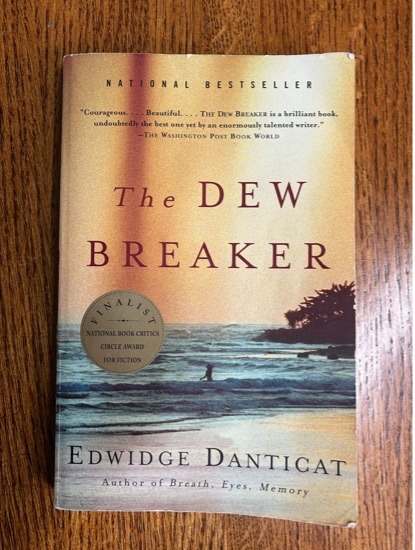
The Dew Breaker is her fourth fiction novel, but is based in true historical context. A kind of mosaic, each chapter takes place in a different location, at a specific point of time, from a new perspective. Danticat maintains her sharp, evocative writing style throughout each of these shifts, while giving proper attention to each character and how their unique life fits in this grand, yet tragic puzzle. At its core, The Dew Breaker tells the story of how one man can affect the lives of many long after he is gone, or has decided to be someone else.
The crux of this novel is the Duvalier dictatorship in Haiti, a time marked by a François Duvalier, physician turned politician, and his bottomless desire for power, respect, and wealth. Colloquially known as Papa Doc, Duvalier ruled from 1957 to 1971. Early in his reign, he purged the majority of Haiti’s army to prevent future attempts at a coup and established the Volunteers for National Security (VNS), a lawless paramilitary force otherwise known as the Tonton Makouts.
Most, if not all, of these volunteer ‘soldiers’ were not officially trained in any capacity. They were ordinary boys and men fueled by nationalism, a longing for status, or simply to do onto others what was done to them and their families. Danticat explores some of these troubling motives near the end of her novel:
“Others relished returning to the people in their home areas, people who’d refused cough syrup for a mother or sister as she sat up the whole night coughing up blood. Some would rather ‘disappear’ the schoolteachers who’d told them they had heads like mules and would never learn to read or write.” (p. 187)
‘Dew breaker’ is another name for these soldiers, deriving from their tendency to “come before dawn, as the dew was settling on the leaves,” (p. 131) and take citizens accused, or suspected, of political defiance from their homes. The man driving Danticat’s story forward was once a choukèt lawoze, dew breaker, before disobeying orders and fleeing the prison where he worked, and soon after, the island he called home. Readers never get a name for this man, the man, but we learn to recognize him by his widow’s peak and a “blunt, ropelike scar” (p. 5) that runs down the right side of his face. An omission I believe highlights how his identity lacks any semblance of permanence, how he’s had to abandon himself time and time again to go from boy to man, man to soldier, and soldier to husband and father.
The Dew Breaker is a character-driven story, so the point of climax is not a major plot twist or a new, shocking event. Rather, expect to experience something akin to the satisfaction of finishing a puzzle. Each moment, interaction, and conversation leads to the finale, and it is there that everything quietly and brilliantly slips into place.
Further on this point, you must care about the characters to enjoy these 242 pages, and thanks to Danticat’s profound yet succinct style, intrigue was effortless. The people in her pages feel real despite intentional, interesting gaps. Take Romain, for instance, childhood best friend to one of our main characters. When we meet him, he quotes Voltaire in the midst of an uprising against Duvalier’s successor, and plans to flee Haiti to escape memories of a fatherless childhood. His presences takes up little over twenty pages; we never learn of his destination, or if he even survived the journey. But because I could see this young man before me, I found myself craving more information about him. I wondered if he wished there were more philosophers that shared his heritage or if he, surrounded by constant political turmoil and lacking a paternal figure, thought his people incapable of deep, scholarly work.
To me, any book worth reading should trigger new trains of thought, must stimulate the mind to see and interact with life in different, always slightly better, ways. The Dew Breaker certainly meets this standard. Primarily, it was fascinating to encounter what people are willing to forget once they find themselves in positions of power. When our Dew Breaker was a boy, he experiences needless tribulations at the hands of Tonton Makouts. And yet, a decade later he chooses to commit his life to the same president and similar corrupt work.
Additionally, I thought about violence, and how despite our best efforts to pretend it doesn’t happen, reality tells us this is a typical occurrence in many lives. In an interview about Paradise, Toni Morrison speaks eloquently about the motivations behind violence and says, essentially, that people convince themselves something will fall if they don’t commit a vicious act. Within the parameters of The Dew Breaker, these motivations come from a place of vengeance; it is easier to ruin another life than accept that strangers had the power to ruin yours.
It came as no surprise to learn that seven of these nine chapters previously existed as short stories. They each stand strong as narratives, masterfully balancing rich, intimate details and broad social standpoints on Haiti’s past and future. Danticat transports her readers from the bustling streets of East Flatbush on a weekend to a quiet sunrise in the Haitian mountainside, or to a night in Port-au-Prince among vendors selling fried plantain and goat, complete with kids licking the bones clean until they “squeaked like whistles and clarinets” (p. 195). Danticat skillfully threads these fragments together to create a story that is memorable and powerful.
As a Haitian-American who refuses to compare my island to countries that invest billions in distraction and vice, The Dew Breaker is a skillful demonstration of an age-old adage: the only way out is through. Progress becomes impossible if we are all struggling, or refusing, to cope. A lasting and effective path forward becomes possible only when we collectively acknowledge and accept our entire past. How lucky are we that this can be accomplished by reading a great book?
Pascale Joachim is a young Haitian-American writer with aspirations of sustaining herself by giving the written word the attention it deserves. Her main priority is freeing herself from student debt, but she keeps the dream alive by reading often and participating in her community writing group. She has published work in The Stratford Crier, has an essay in the anthology Fast Famous Women, is moderately active on Medium, and has fiction and nonfiction work forthcoming in other publications. Feel free to connect with her via email at pjoachim255@gmail.com.


