

Waste Management in Stratford
In March, Stratford was among nine municipalities awarded a grant in the inaugural Materials Management Infrastructure (MMI) Grant Program. A total of $15 million in grant funds — to date the state’s largest investment in local and regional waste management infrastructure — were made available through a “competitive application process to Connecticut municipalities, councils of government, and regional waste authorities to support the development of waste management infrastructure in direct response to the solid waste disposal challenges that are impacting these entities,” according to the Connecticut Department of Energy and Environmental Protection.
Town Composting:
Summary of Stratford Town Council Meeting Minutes from January 13th:
The Town of Stratford will engage with Park City Compost Initiative, Inc. (PCCI), to operate a food scraps compost program in an area adjacent to the existing municipal transfer station. The goal of this proposed program is to reduce the volume of waste entering the regular municipal solid waste cycle by separating food scraps that will then be turned into finished compost through natural aerobic processes completed onsite. The Town and its residents will benefit fiscally from reduced tipping and shipping fees while also obtaining nutrient-rich compost that can be shared with individuals as well as municipal agencies.
This funding has been made possible from the CT DEEP’s Materials Management Infrastructure Grant Program; and the Town of Stratford expends funds to maintain solid waste and recycling at the Stratford Transfer Station; and it is desirable and in the public interest that the Town of Stratford enter into an agreement with CT DEEP in the amount of $554,583 with $452,360 in Town Match, which will be in the form of in-kind services.
The food scrap composting program will be at the Transfer Station and is presently being developed. It is expected to be up and running at the end of the year.
Transfer Station:
The transfer station itself does not permanently store waste. It functions as a facility where waste collection vehicles unload collected trash.The Town of Stratford sends our waste to the Transfer Station on Watson Boulevard. The transfer station consolidates and ships waste to WIN Waste Innovations Resource Recovery in Bridgeport for final disposal. The transfer station is a middle point for sorting and consolidating of waste before it is trucked to WIN Waste in Bridgeport.
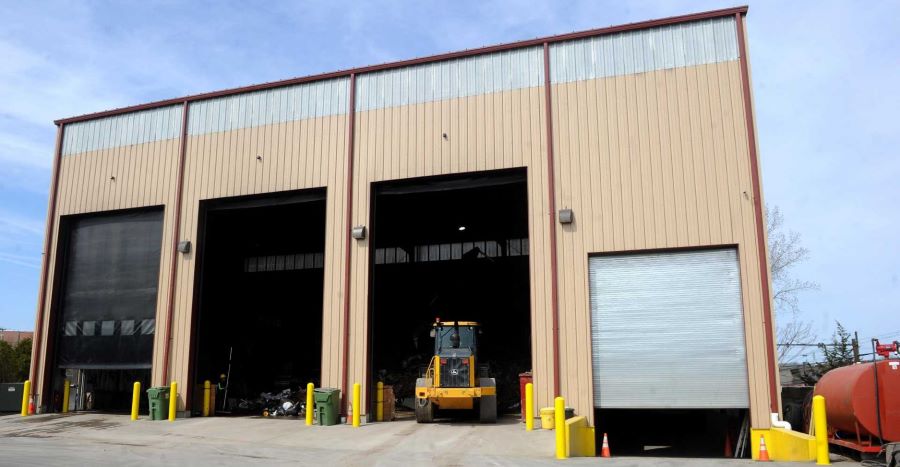
The Stratford Crier reached out in a telephone call to Gary Catalano, Superintendent of Sanitation, who said, “Our transfer station has separate areas for designated waste: sections include bricks and stones; cardboard, which we now have to pay to get rid of; electronics, picked up by Take 2 Recycling in Waterbury. Take 2 Recycling pays us a nominal feel for the electronics; waste oil is used to heat the mechanics garage; yard waste, ground and used for compost for town; waste with CFCs* (e.g. air conditioners, refrigerators), which we evacuate and then bring for reimbursement to a CFC recycling company; and our metals go to a scrap metal yard.”
*(Editor’s Note: CFCs are chlorofluorocarbons and are used in aerosols sprays, solvents and refrigerants. With a few exceptions they have been phased out in the U.S.)
“Stratford pays $88.66 per ton for the garbage it transports to the WIN Waste Innovations plant in Bridgeport,” Catalano continued. “This plant is a waste-to-energy facility that converts trash into energy by burning it. Stratford sends approximately 26,000 tons of trash to this facility annually.”
Stratford has an agreement with the Greater Bridgeport Regional Solid Waste Committee, which has 10 towns participating in the project of moving food waste from the waste stream, and a board requiring the town to deliver its solid waste to the facilities designated by the committee, WIN Waste in Bridgeport. Members of the Greater Bridgeport Regional Solid Waste Committee are:
Greater Bridgeport Regional Solid Waste lnterlocal Committee
Members:
Bethany: Bruce Loomis Easton: Ed Nagy
Fairfield: John Cattell, John Marsilio Milford: Chris Saley,
Monroe: Christopher Nowacki Southbury: Blake Leonard,
Stratford: Gary Catalano
Trumbull: Maria Pires
Westport: First Selectwoman, Jennifer Tooker, Peter Ratkiewich Woodbridge: Anthony Genovese
Source: Greater Bridgeport Regional Solid Waste lnterlocal Committee Minutes
Location: The transfer station is located at 205 Watson Blvd, Stratford, CT 06615.
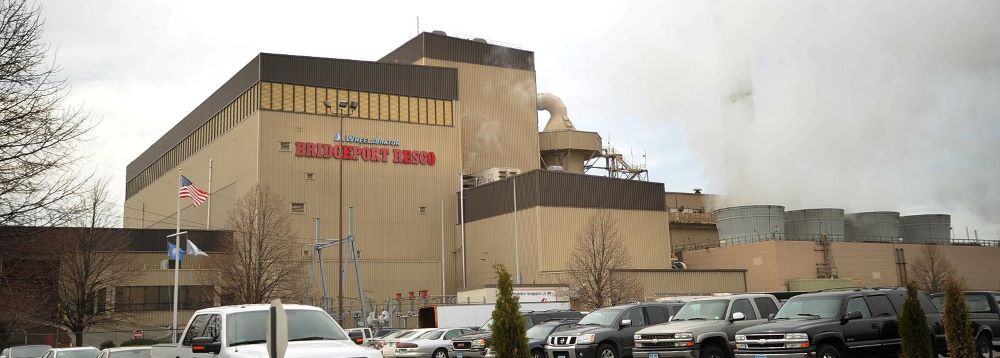
Photo by Connecticut Post
According to Mary Urban, Senior Director of Communications and Community, WIN Waste Innovations Resource Recovery Facility, “Each year, WIN Waste Bridgeport converts about 737,000 tons of post-recycled waste into renewable energy through a highly efficient combustion process that meets strict federal and state standards. The renewable energy generated at the Bridgeport waste-to-energy facility is enough to power the equivalent of 43,900+ local homes and businesses.”
The Bridgeport facility processes 2,250 tons of waste each day, including 19,000 tons of metals recovered each year for further recycling. Urban also claims that across all of WIN Waste’s waste-to-energy facilities, processing one ton of waste avoids up to two tons of carbon dioxide equivalent (CO2e) into the atmosphere.
“Connecticut is facing a waste crisis, as traditional options for disposing of municipal solid waste (MSW) are diminishing or becoming more expensive,” officials of the Connecticut Department of Energy and Environmental Protectionwrote in a news release. “With fewer, and rapidly aging, disposal options located within the state, residents and municipal leaders can expect to see increasing disposal costs over time as more waste is shipped out of state. The MMI grant program is designed to help municipalities and regional entities respond to this crisis, by providing grant funds to develop small- to medium-scale waste management infrastructure.”
In 2015 the Connecticut Department of Energy and Environmental Protection did a statewide waste characterization study. At that time, they characterized Food Wasteat 519,832 tons, or 22.3% of the waste stream in Connecticut.
Recycling Bottles and Cans:
Returnable Container Management LLC is a subsidiary of Galvanize Group, a New York based business that includes recycling of returnable containers, but also real estate development, logistics and transportation, and retail and commercial laundries.
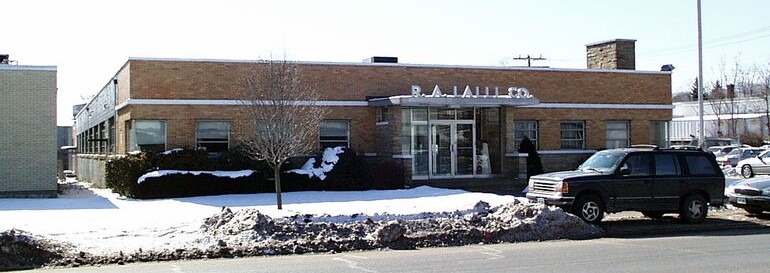
Photo from Hartford Business Journal
The redemption center is at 1855 Stratford Avenue, and they accept all bottles and cans with a CT Deposit stamp. According to their website: “No Limit, No Waiting, FAST CASH OPEN TO THE PUBLIC! Bring ALL glass plastic and cans mixed, no separation required.10 CENTS paid for every bottle and can!”
In 2024, Connecticut increased their bottle redemption rate to $0.10, which has attracted out-of-state containers, creating a significant problem with out-of-state bottle fraud. New York and Rhode Island pay $0.05 per redeemable containers. Complaints have been so numerous that Governor Lamont signed a bill last month intending to prevent hordes of out-of-state traffickers from making an extra nickel in Connecticut by collecting a 10-cent refund on cans and bottles that required only a 5-cent deposit in their state.
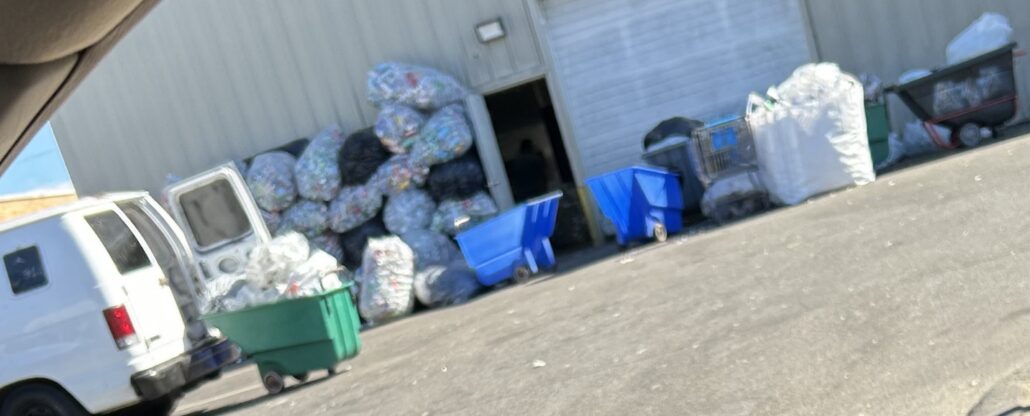
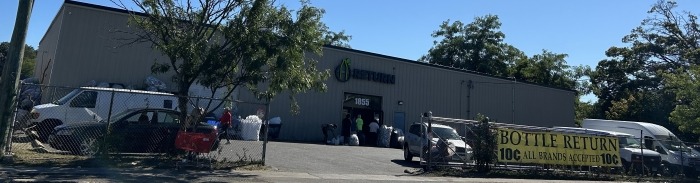
Connecticut’s beverage container redemption rate rose from 44% in 2023 to 65% in 2024 due to “significant deposit return system program improvements” phased in over the last few years, according to data from the Container Recycling Institute. In the last quarter of 2024, the bottle return rate in Connecticut reached 77%, the highest it has ever been.
Food In The Waste Stream:
At this point in time, there is only one organization that is addressing the environmental impact of food in the waste stream. Havens Harvest serves the Greater New Haven, Lower Naugatuck Valley, and New London regions.
In a telephone interview with Lori Martin, Executive Director of Haven’s Harvest, she said, ”September 2nd marked the tenth anniversary of the start of this project, which transformed into an organization. It was my son Caleb’s idea because he had friends who had dumpster dived at Trader Joes. His idea was to reach out and ask the store if they were still throwing away their food. If so, he wanted to pick it up and get it into the community. That was the ‘butterfly wing’ action that started this all. We focus on the environmental impact that excess food has when thrown into the waste stream—when in a landfill or an incinerator, food emits methane which is 28 times more toxic than carbon dioxide.”
The company does not collect “scrap” food, but targets perishable or prepared foods that only have a few days left to be eaten, it is very important that the food donated by a partner site matches with a receiving site that can use the food for their community. They fed these communities over 1.5 million pounds of food in 2023. In 2024 alone, food that had been retained in our communities is valued at $43,913,220, which is equivalent to preventing over 3,891,975 pounds of CO2 emissions from being created, according to Martin.
There are over 400 partner sites- including food pantries and soup kitchens, daycare centers, senior centers, schools, subsidized housing sites, clinics, faith communities, and other nonprofit organizations.
There are over 400 volunteers that pick up food from donating sites and deliver it to receiving sites in the Greater New Haven area, Lower Naugatuck Valley, and New London regions, and includes 100 sites that were a home delivery pilot.
Food Fact: Food Waste Is a Bigger Polluter Than Cars!
When food rots in landfills, it releases methane, a greenhouse gas 25 times worse than CO₂. In fact, food waste produces more pollution than most cars on the road! Global food waste accounts for nearly 10% of global greenhouse gas emissions, making it a major contributor to climate change.Scrap food is for animals or compost- not for people. Composting and food recycling can help reduce this impact.
Sources: Tim O’Connor, Park City Compost Initiative Inc; Jeffrey Costantino and Nate Clark, ReFED; Havens Harvest; Gary Catalano, Stratford Superintendent of Sanitation and Garage; U.S. Composting Council; Lori Martin, Executive Director, Haven’s Harvest; Container Recycling Institute; Connecticut Department of Energy and Environmental Protection; Industry Kitchen Equipment Blog


