


Stratford: The Stories We Tell
Whether you believe Gustave Whitehead was the first person to successfully fly an air machine or not, there has always been something that has drawn aviators to Stratford.
In 1911, at the Avon Park Aerodrome (located, roughly, where Sikorsky Memorial Airport lies today), a group of some of the finest and most intrepid aviators gathered for one of the first, and largest, aviation shows of that day. In 1911, Glenn Curtiss for a time considered constructing his airplane manufacturing facilities in Stratford. In 1914, the Army brought their first airplane to Stratford on a train car, and flew it in mock battle. This was the first time an airplane had been flown in battle by the military.
The (Stratford/Mollison/Bridgeport/Sikorsky) airport was built in 1928, due to the fact that Igor Sikorsky wanted to move his manufacturing facility to Stratford from Long Island. Undoubtedly, Sikorsky was well aware of all the aviation activity in Stratford during the early 1900s. Amelia Earhart came to Stratford in 1929 to pick up her new Avro-Avian airplane. Charles Lindbergh came to Stratford several times to meet and collaborate with Igor Sikorsky. And then there was the Vought-Sikorsky Corsair, the fastest fighting airplane of its time, manufactured here.
All of this aviation activity did not go unnoticed. In 1928, Germany began the first regular transatlantic zeppelin air service, linking South America with Europe. That same year, Igor Sikorsky had launched the Sikorsky S-38 amphibious plane for transatlantic passenger service. The major differences between the two very different aircrafts came down to speed and passenger seating capacity. The S-38 could only carry about eight passengers while the German Graf Zeppelin (built in 1928) could hold 24 passengers, and those passengers could travel in style. The cruising speed of the Graf Zeppelin was 80 mph, while the S-38 could reach a top speed of 130 mph.
When the von Hindenburg zeppelin (known in America as the Hindenburg) was built in 1926, it typically carried 97 passengers in roomy comfort and carried 11 tons of freight. The von Hindenburg could travel at a top speed of 84 mph. Thirty years of airship construction knowledge had gone into the development of the Hindenburg. The Hindenburg took three years to construct.
The Hindenburg was 813 feet long. It had hot and cold running water and showers in each passenger cabin. Passengers could dance to piano music in the lounge. Adolph Hitler was very proud of Germany’s aircraft manufacturing capabilities in 1936, and strove to demonstrate that superiority as often as possible. America’s largest zeppelin, the Los Angeles, was a much smaller airship.
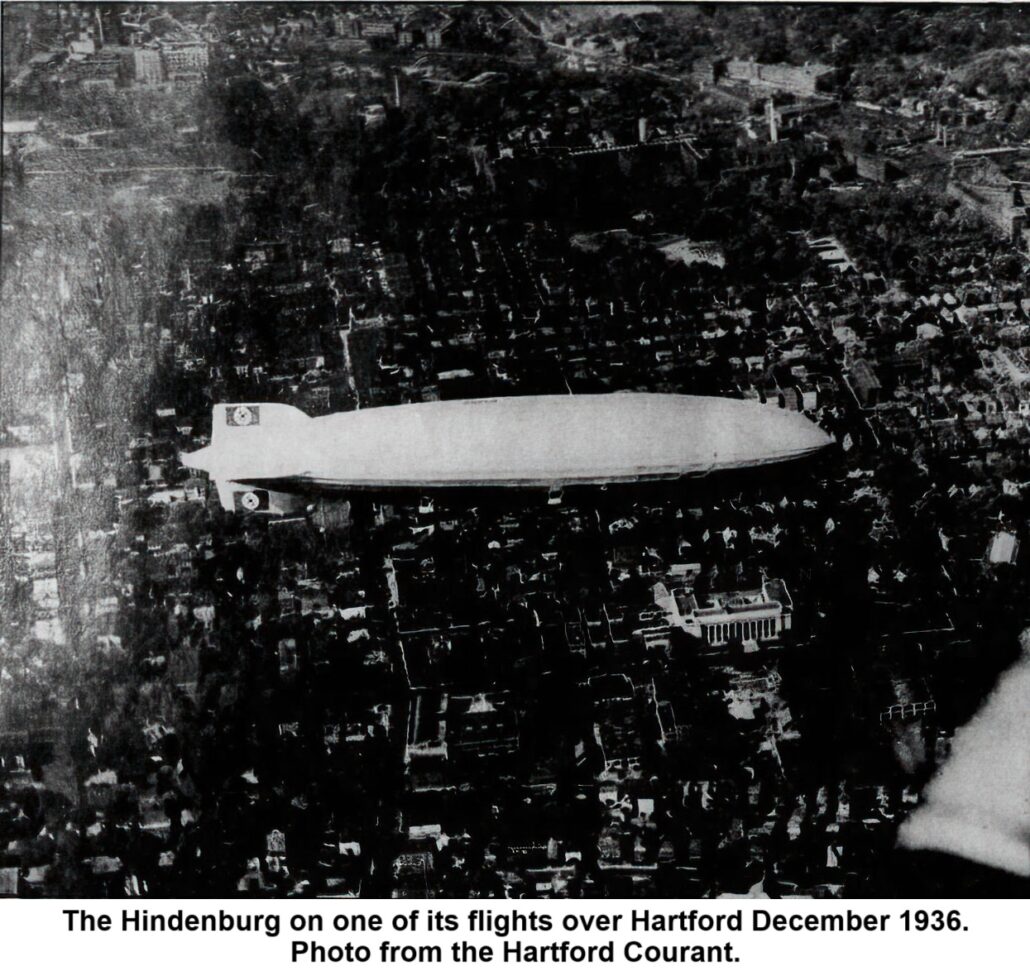
United Aircraft had its huge aircraft manufacturing facilities in East Hartford. On January 1, 1937, Frank Hawks flew a new speed plane into Rentscheler Field to demonstrate its incredible air speed. Coincidentally, or not, the Hindenburg flew over Renscheler Field at the same time. We don’t know the Hindenburg’s exact route from Hartford to Lakehurst, NJ in 1937, but we do know that the huge airship flew over Stratford during that visit to America.
A few months later, in May of 1937, the Hindenburg again flew a route which carried it over Stratford. We have a wonderful photo of the zeppelin as it passed over Stratford Point. Now, if you’re Hitler, and you’re obsessed with German dominance in all aspects of life—manufacturing, evolution, and government—might the Hindenburg’s path over Stratford been just a bit more than coincidence? With Hartford and Stratford’s aircraft manufacturing reputation, if you’re Hitler, you just might want a bird’s eye view of airplane manufacturing in Connecticut in 1937.
While we’ll never know what was in the minds of Germany’s leaders in 1937, we do know that the Hindenburg flew a path, no doubt taking it down the Housatonic River and over the Sikorsky plant, to Stratford Point, and on to New Jersey.
A friend of mine recently brought me a 1937 photo of the Hindenburg as it passed over Stratford Point. Perhaps my questioning mind was working overtime, but I could not help but speculate about the Hindenburg’s flight over Stratford as just a mere coincidence. My theory is, that 1937 flight over the Sikorsky plant was no mere coincidence.


never knew that the hindberg flew over stratford point
great stories
what going on with you
i been voluntering at the boothe memorial over the summer
and going back to the judson house in october