


The Black community in Stratford has a storied history. For instance, we often hear of the Stratford location, Mac’s Harbor. Mac’s Harbor is on Shore Road just south of the Housatonic Boat Club. The harbor is named for Mack, a free Black oysterman who ground oyster shells at this location to create plaster for house walls. Mac operated his oyster “calcining” operation in the 1800’s.
Stratford is also unique from the aspect that 32 Black Stratford enslaved men fought for the American cause during the Revolutionary War. With the exception of Colchester, Connecticut, no other Connecticut town was home to more Black Revolutionary War soldiers and sailors than Stratford. Of course, at the time of the Revolutionary War, the Town of Stratford included the towns of Shelton, Monroe, Trumbull, and about half of Bridgeport. Some of these soldiers and sailors lived outside of Stratford’s boundaries of today.
One of these soldiers, Jack Arabas, was promised his freedom from slavery if he took his enslaver’s place in the War. Thomas Ivers was Jack’s enslaver. When Jack returned, after seven years, from the war front, Ivers refused to grant Jack his freedom. Jack sued for his freedom in Connecticut’s second capital city in 1783, New Haven, and won. As a result of Jack’s court fight, many other enslaved former soldiers were also granted their freedom when their enslavers refused to grant them their freedom.
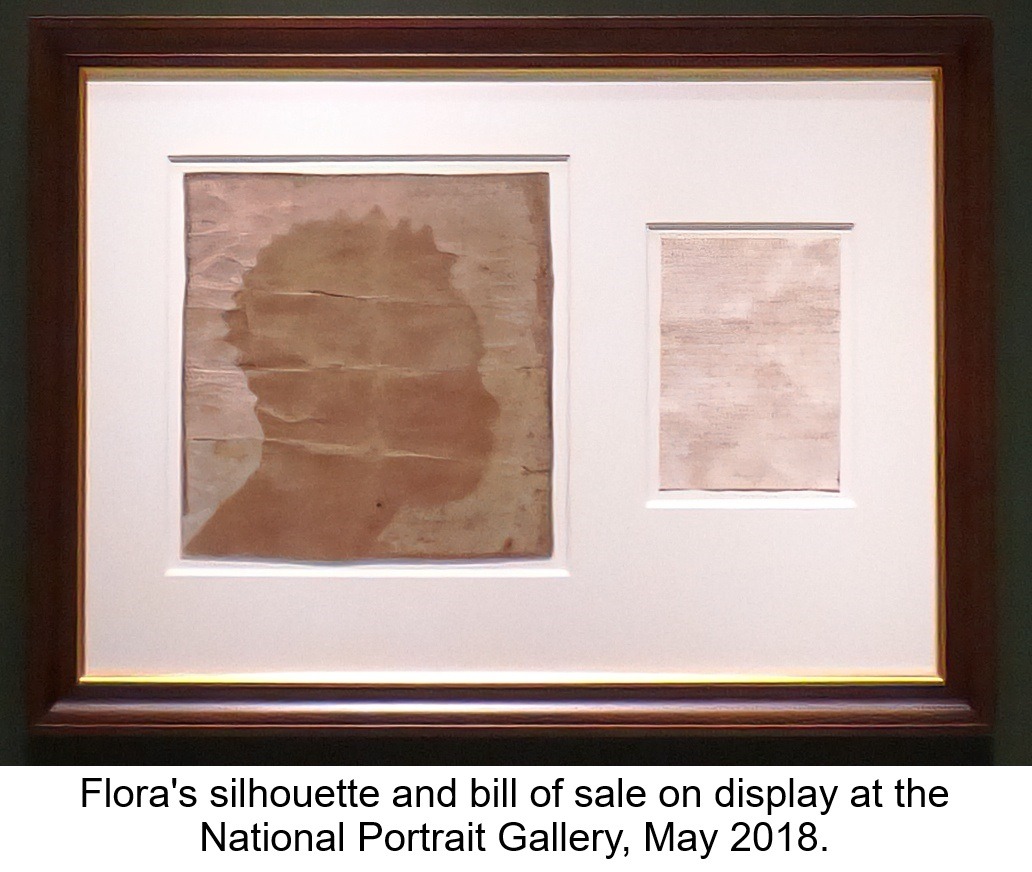
Perhaps one of the most significant historical items from Stratford’s history is the silhouette of “Flora the Slave girl” and her bill of sale. In 1925, when the newly formed Stratford Historical Society took possession of the Captain David Judson house, two very old documents were located in the basement of the Judson House. One was a bill of sale for one “Flora”, an enslaved woman from Milford, and the other was a silhouette of Flora’s face. The silhouette was life-sized. No other life-sized silhouette of an enslaved person has ever been found in America.
Flora’s silhouette has been exhibited all over the United States. It has been featured in a number of books, one of which was produced by Oxford University in England. The British Broadcasting Corporation ran a special program on Flora’s unique silhouette and bill of sale. Flora’s silhouette was featured for over a year at the Smithsonian National Portrait Gallery in Washington, D.C. as part of their “Black Out” presentation in 2018-2019.
Flora’s silhouette has come to represent the pain and heartbreak of the “peculiar institution” of slavery. Flora was only 19 years old when she was ripped from her family in Milford and sold into bondage to the Asa Benjamin family in Stratford in 1796. Flora passed away in bondage in Stratford about 1820.
It is believed that Flora’s silhouette was drawn by a fellow enslaved person as a memento realizing that the silhouette was all that her family would have left of Flora once she was taken to Stratford. Undoubtedly, many tears were shed as this silhouette was being created. Enslaved persons were not allowed to cross the Housatonic River without their enslavers’ permission. Furthermore, it is believed the silhouette was made shortly before Flora was taken to the Benjamin family.
How Flora’s bill of sale and silhouette ended up in the Judson house has never been determined. The Benjamin family never resided at the Judson house. The Stratford Historical Society has Flora’s silhouette, and bill of sale, on exhibit in their museum. It is a very stirring reminder of a time when all American people did not enjoy the blessings of “life, liberty, and the pursuit of happiness” claimed in the Declaration of Independence.

