


Prior to 2005, Stratford’s town motto had been: Stratford. A Town for all Seasons. Traces of the former motto can still be located around town. Some residents, tongue-in-cheek, contrived a derivation on that theme which was: “Stratford. A Town for No Reason.” In 1921, for many town residents Stratford was, indeed, a town for no reason.
Opinions on the future of town were basically divided between four schools of thought: 1) merge with Bridgeport because taxes were too high and services provided for the taxes paid were too meager; 2) create a new town charter which would bring Stratford’s government into the 20th century; 3) merge with Bridgeport because it would be much more conducive to commerce; and, 4) do nothing because Stratford was just fine the way it was.
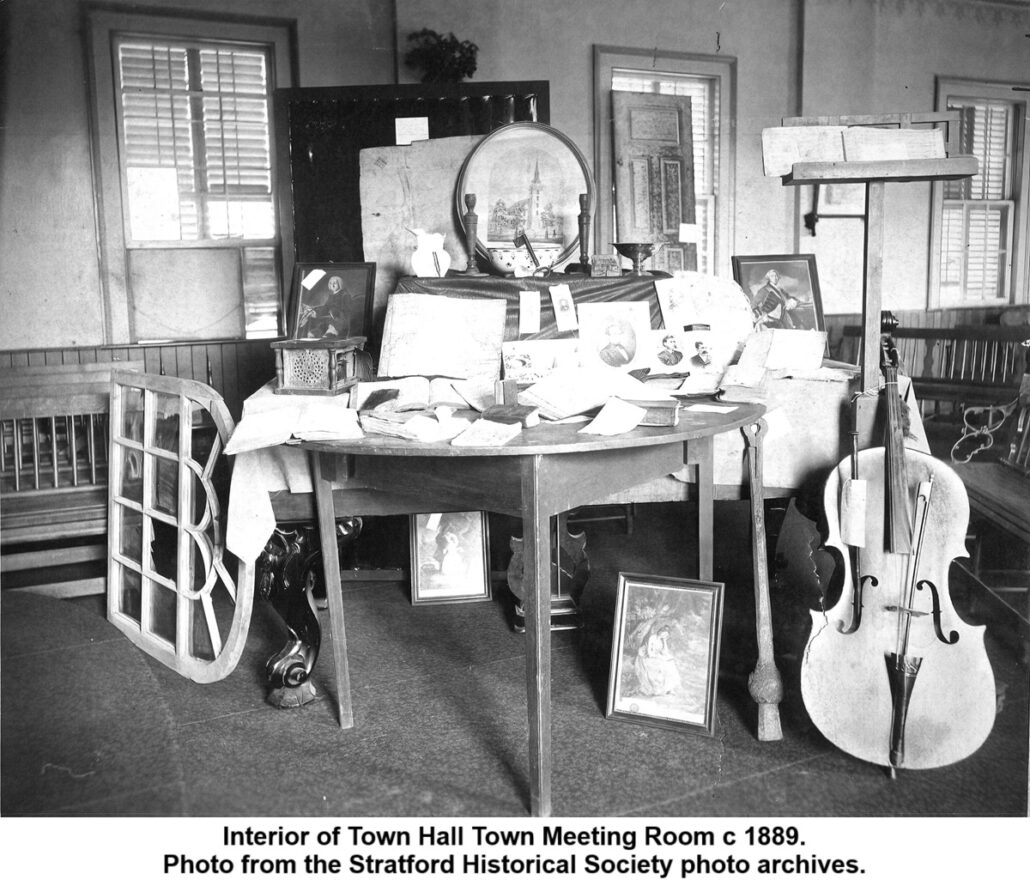
To understand where Stratford stood in 1921, it’s important to understand that all town business was conducted via a New England style town meeting. Stratford’s town hall could only accommodate about 200 attendees. Participation in the Town Meetings, therefore, was on a first come – first served basis. This type of town meeting served Stratford fairly well, as long as Stratford was a town of several hundred residents. In 1921, however, Stratford’s population was approaching 15,000 residents, and population growth projections for the future were explosive.
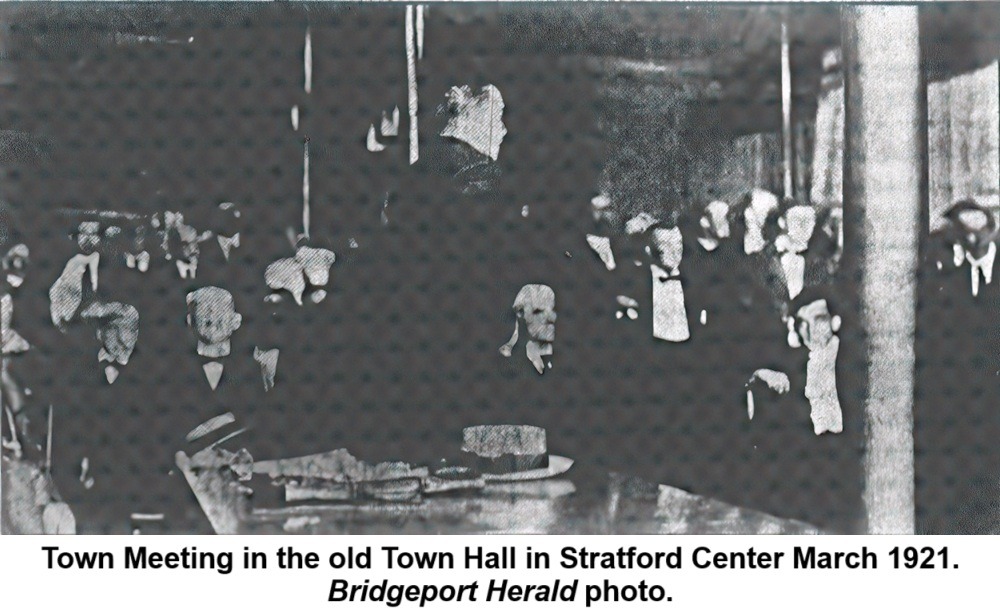
Additionally, Stratford women had never been welcomed to town meetings. Town meetings were largely the province of the men in town. Town meetings were usually filled with those who arrived early to vote against anything that did not suit the personal interests of the attendees. Speeches given during town meetings frequently droned on endlessly, often completely unrelated to any town matter.
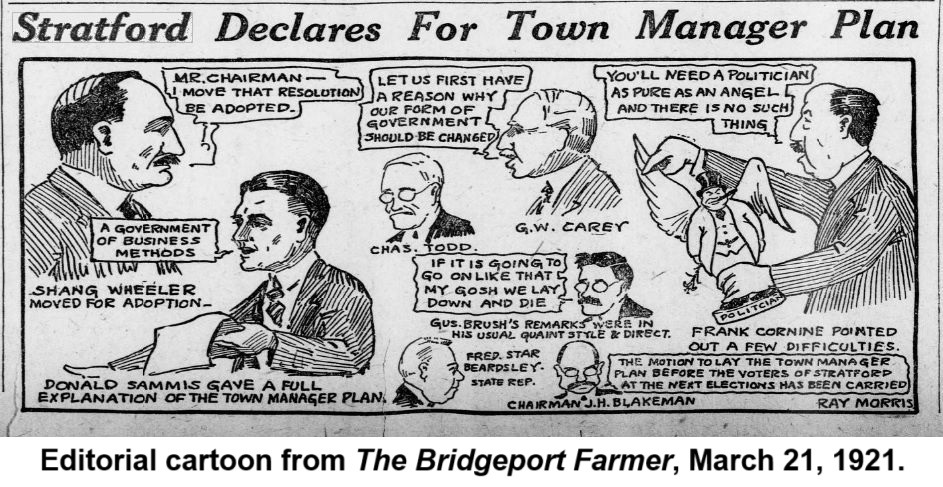
Some of the younger Stratford men recently returned from the Great War, along with some of their elders, realized that most Stratford residents no longer had a voice in their town’s governance. Donald and Frank Sammis crafted a new town charter, featuring, among many other things, a Council-Manager form of government. Donald Sammis had done a great deal of research on the subject of town governance, and found that a Council-Manager government form was succeeding very well for very many towns across America.
Open, local meetings were held all over town to discuss the proposed charter. The meetings began in 1920 and continued on through 1921. Most Stratford residents realized something had to change in Stratford’s government, and had to change soon. Otherwise, Stratford would be consumed by Bridgeport’s insatiable need for more land.
During 1921 alone, a proposed tax to buy a new fire truck, to aid the starving poor in town, to pay the school teachers, and to hold a town election on the proposed charter were all voted down by the early-arriving naysayers at the town meetings. There had been two large fires in town during 1921, including the Center School fire. Yet, those attending the town meetings where a tax was proposed to buy a functional fire truck saw the naysayers defeat the proposal for a tax increase.
Stratford’s proposed charter was revolutionary in that it allowed for a recall vote for town council members, and proposed that women have an equal say in town government and elective offices.
Leading up to the vote on the charter in 1921, no one knew what the outcome would be. Many thought the vote would fail. No one could predict how the newly enfranchised women would vote. As it turned out, the women overwhelmingly voted to preserve Stratford as an independent town, and to clear from office all those men who were making life in Stratford undemocratic and unrepresentative.
It would take a recall election, the first of its type in Connecticut, to finish transforming Stratford’s government. The Town Council fired its first distinguished and highly experienced Town Manager, Rutherford Hayes Hunter, just months after he was hired, for purchasing “ash cans” without first asking permission from the newly elected Town Council.
The voters were livid with the Council for firing Hunter. A special recall election was called and all the Council members who had supported Hunter’s firing now found themselves fired by the voters. The succeeding Town Council rehired Hunter. Democracy was at last taking a firm hold of Stratford.


That article chronicling the evolution of democracy in Stratford was excellent and timely. We the people spoke up in Stratford. We the people can speak up and surely rise up to bolster the Democratic process and the teetering Democracy across the entire country.