


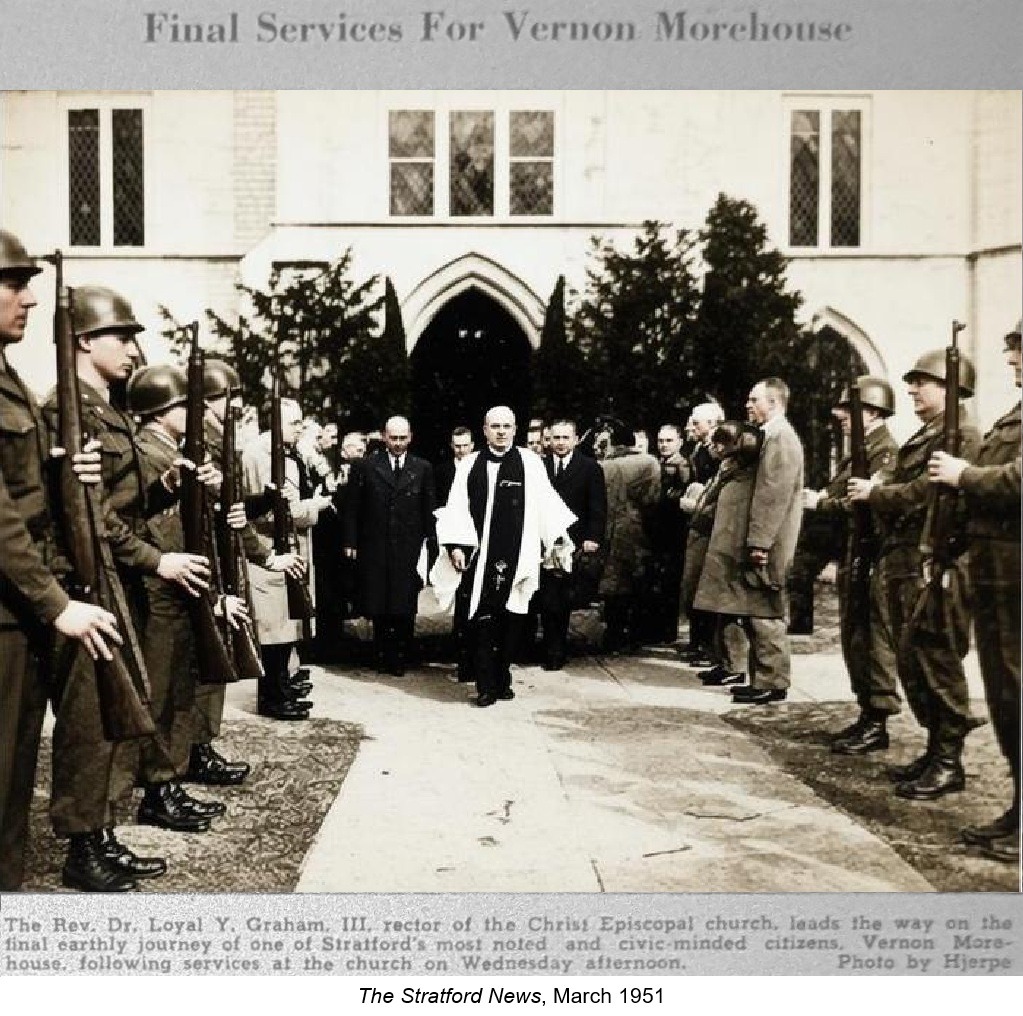
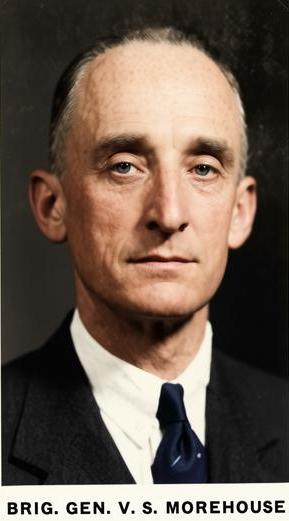
Brigadier General Vernon S. Morehouse, a native of Stratford and a descendant of William Beardsley, was State Director of Selective Service at the time of his death on March 18th, 1951. He was a well-known figure in the Town of Stratford, having served for 14 years as the Town Council Chairman.
General Morehouse was very involved in Stratford’s 300th anniversary, dearly loved his native hometown, and refused several lucrative offers so that he could remain residing in Stratford.
Vernon, and his brother Ivan Morehouse were extremely active in Stratford’s political life. They lived their lives in their homes on East Broadway. Both were born and reared in their father’s home on East Broadway. Vernon was deeply partisan, to the point that he could not bear having Roosevelt Forest named for a Democratic President. He formed a committee in 1939 to find a new name for Roosevelt Forest, more in keeping with his political persuasion.
Vernon’s attempt to rename Roosevelt Forest began reverberating throughout America in December of 1939. Newspapers from Florida to Maine and from New York to California carried articles about this “little town in Connecticut” which was disrespecting the President of the United States. Interestingly enough, Roosevelt Forest had been named by Town Manager Donald Sammis in January of 1934, on Franklin Roosevelt’s birthday, as a way of honoring the President for this significant contribution to Stratford.
Yet, five years later, when pressed for an answer to the question of “for whom was the forest named”, Mr. Sammis responded that he named the Forest for Franklin, but had Teddy Roosevelt in mind. Mr. Sammis told Town Historian Lewis Knapp that he would take the secret of whom he had named the Forest for to his grave. That worked until a careful search of newspapers from 1934-1940 proved that everyone at the time the Forest was named knew the Forest had been named for Franklin Roosevelt and not Teddy.
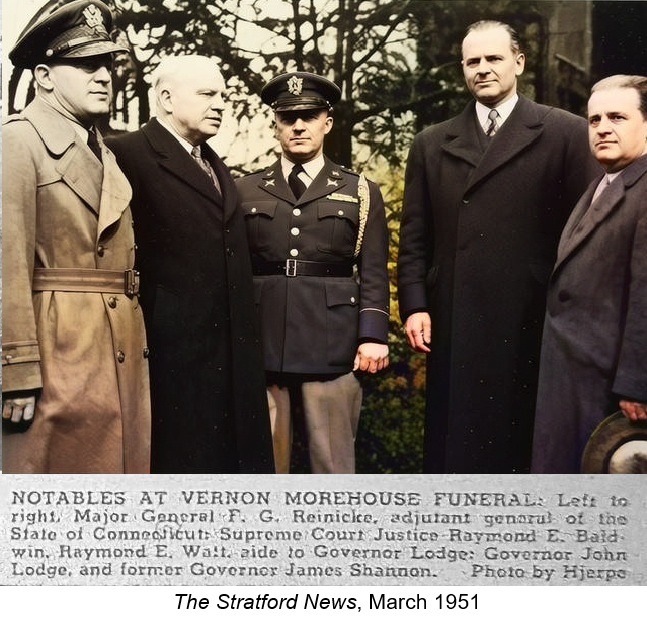
Ultimately, Governor Raymond Baldwin, a long-time resident of Stratford and a man who cut his “political teeth” in Stratford, became involved. He sent a nonsense letter to Vernon Morehouse in 1940 demanding Morehouse not rename the Forest. Franklin Roosevelt, through the Works Progress Administration, had spent about $500,000 on Stratford Public Works projects and local employment from 1934 to 1939. Governor Baldwin thought that was sufficient reason to retain the name “Roosevelt Forest.” Vernon, of course, disagreed but dropped the matter.
Nonetheless, Vernon’s impact on Stratford for the good was felt for years. Mr. Morehouse loved his hometown. On November 3, 1950, The Stratford NEWS printed an article written by the late general on “Why We Should Be Proud of Stratford”. Vernon Morehouse’s love for the town shows through the extracts of this article which are printed below:
March 23, 1951
Vernon Morehouse Article Told Of His Love For Town
Stratford has, I believe, everything that a town steeped in the traditions of 300 years and now confronted with modern problems of growth and development, has to extend to potential citizens seeking a better place to live or establish new industrial and commercial enterprises.
Located on the historic, scenic Housatonic River, with nearly 15 miles of waterfront extending along the river and Long Island Sound on the southern boundary of the town, offering boating, fishing, and swimming, in both fresh and salt water, with acres of park and wooded areas for recreation, situated close to the New York City metropolis and readily accessible by the scenic Merritt Parkway to other smaller cities and communities for either business or pleasure motor journeys. Stratford extends opportunities and space for industrial developments and home sites within zoned areas.
It affords a haven to all seeking a town in which progress and future development opportunities are quite unexcelled and where both the various advantages and pleasures of a modernized town with an old and historic background are combined with the geographical and physical environments of nature seldom found in other communities. Our home sites and industrial areas for development afford locations either along the waterfront, in the more urban and country sections, or in the case of industries in areas along and adjacent to both railroad facilities and inter-state highways for auto truck transportation of industrial products.
…While Stratford has not reached perfection and there have been, and are errors, oversights, and misjudgments made by some of our citizens as well as those selected or elected to administer the town government, these may well be overcome by thoughtful study and outspoken constructive criticism of the citizenry of the town as a whole. Other communities which have been more or less stagnant and backward in their development have made similar errors and misjudgments as Stratford, and causing criticism of Stratford’s errors should not be overemphasized. It is not with the idea of any narrow, warped criticism that I mention that our town has its faults, but rather with the idea of bringing out such facts in order that the town and the citizens may ultimately profit by correcting those conditions which are not beneficial to the town or its citizenry.

