


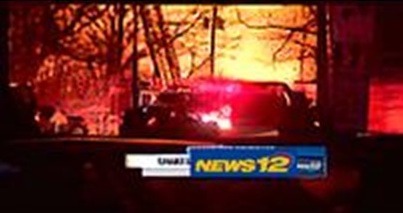
Many of us awoke on Sunday morning, January 13th, 2019, to read, in disbelief, the newspaper headlines and to view the TV news stories describing the burning of the Shakespeare Theatre. The stories were surreal, but the images being broadcast on the TV news were all too real, indeed. By the time the sun rose on Sunday morning, all that remained of the Theatre was a pile of smoking ash, twisted metal, and collapsed concrete.
Like moths drawn to a flame, the news stories weren’t believable until you actually drove by the site of the former Theatre. Most of us could not imagine a Housatonic River skyline devoid of the long shuttered Theatre.
The weathered teak which covered the Theatre was so hard, and seemed so resilient, that it was virtually unthinkable that through the flames of one fire, the Theatre could have been completely destroyed. The Indonesian teak was thought to be fire proof.
You may view a News 8 video of the Theatre’s burning on Youtube at https://youtu.be/Ta9Kf-wpcbg?si=dJkhDzHT-uF_ozgE.
In the hours and days immediately following the conflagration, people from all over the world expressed shock at the loss of the Theatre. Mayor Hoydick and her emergency services personnel held a news conference to explain what little was known of the fire’s origin.
The Mayor formed a new Shakespeare Property Committee to begin the process of determining what would come next for the Theatre property. The committee held several meetings and made their recommendations. At this time, the eventual repurposing of the property has not been determined.
In his plays, Shakespeare had some thoughts on fire which may show a bit of clairvoyance as they relate to Stratford’s Theatre fire in 2019.
Two Gentlemen of Verona, Act 1, Scene II, spoken by Luc: “Fire that’s closest kept burns most of all.”
The Taming of the Shrew, Act 2, Scene I, spoken by Pet: “Though little fire grows great with little wind…”
The Tragedy of King Richard the Second, Act 2, Scene I, spoken by Gaunt: “For violent fires soon burn out themselves;…”
Of historical interest, the Stratford-on-Avon Globe Theatre, in 1613, was destroyed by fire on the 29th of June. During the play, Henry the V, a small spark from a cannon accidentally caught the roof on fire, and in less than an hour the Globe Theatre had burned to the ground.
In 1642, the Puritans in Parliament passed a law that suppressed the production of plays. Puritans felt that the theatre was an ungodly place, and they were perhaps also wary of entertainments that would take people away from church. In 1642, the Puritans ordered the Globe Theatre closed, and it was destroyed in 1644. (From
https://www.enotes.com/homework-help/why-did-puritans-close-down-globe-all-together-61973).
Perhaps the fire was Stratford’s Puritan settlers from 1639 reminding Stratford of all the “ungodly acts” that Stratford permitted on the site of their original settlement. No doubt Stratford’s first Puritan minister, Adam Blakeman, would have felt some of the wrongs of Stratford had finally been righted.

