


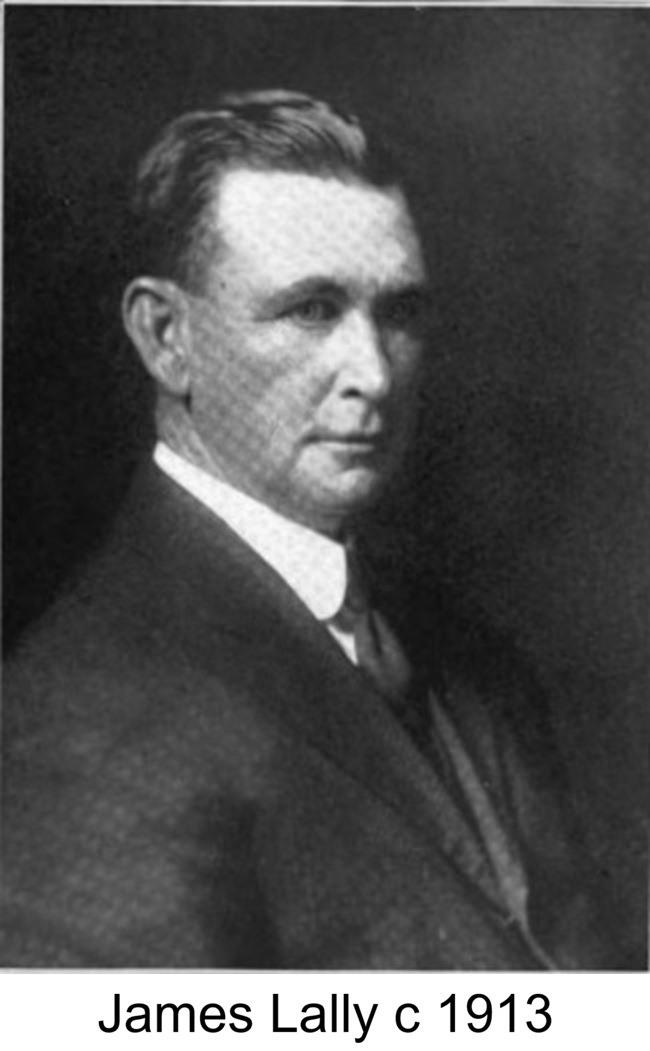
Even though largely forgotten today, James M. Lally will ever factor large in Stratford’s history, as he was Stratford’s last First Selectman. James was born to Irish immigrant parents in 1871. James’ parents came to America and established their home in Stratford in 1857. James was one of seven children, and he attended Stratford’s public school system until he was 16 years old. He then entered the first phase of his working life.
James entered politics as the town’s tree warden in 1909, then was elected Selectman in 1913. James was elected First Selectman in 1915, succeeded himself for an additional term, then was defeated for a third term. In 1919 he ran for First Selectman again, and this time held the position until Stratford’s government changed to a Town Manager/Council form in 1921.
James served his town faithfully during what was, almost assuredly, the town’s most challenging period. Stratford’s population soared from 5,712 in 1910 to 12,347 in 1920. No other decade in Stratford’s history has experienced a 216% growth rate. Due to all the new people moving into town, Stratford was building a new school or adding on to an existing school nearly every year of James’ political career.
Stratford “went dry” in October of 1917, and stayed dry until prohibition was repealed. However, liquor and still confiscations in town kept the local gendarmerie very busy during Stratford’s dry years. Liquor and still confiscations rose 300% from 1919-1926.
The first sewers and power lines were laid during James’ years of public service. A feeling began, and grew increasingly more ardent through the 1920s, to jettison Avon Park and Hollister Heights to Bridgeport. Stratford felt it was too expensive to provide services to these parts of town where so little was collected in taxes.
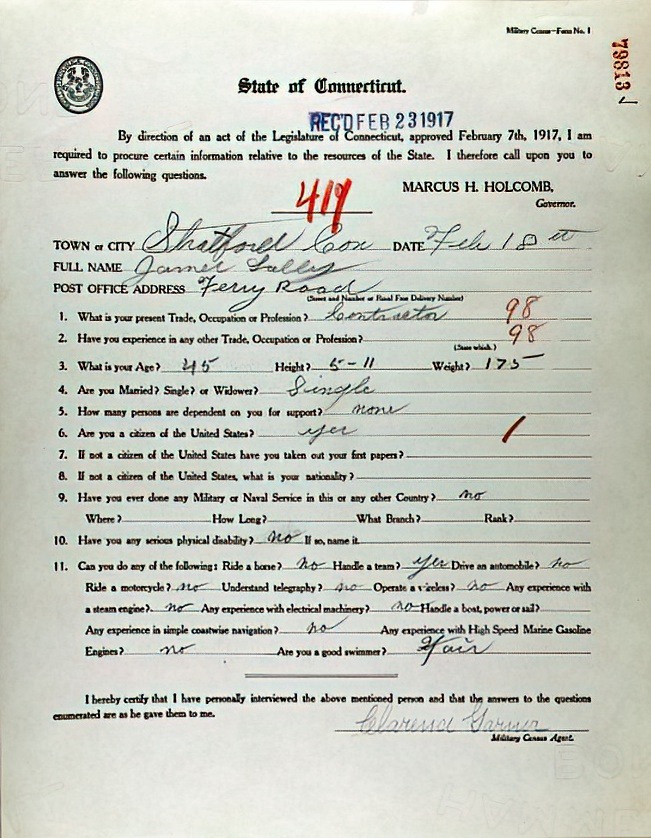
When the draft for World War I began in 1917, draftees from Trumbull, Shelton, Monroe, and Stratford were to depart for basic training on trains leaving the Stratford train station. Mr. Lally learned that nothing had been prepared to send the young men off in a caring fashion. Using his own funds, he held a farewell dinner for the departing young men. Mr. Lally was within the upper end of the draftee range and had to register for the draft himself.
Women were granted the right to vote in 1920. In Stratford, that meant women were able to change the form of Stratford’s government to a Manager-Council form. Most politically connected men opposed changing the form of government. James was succeeded by Stratford’s first Town Manager, Mr. Hunter.
A whooping cough epidemic raged through Stratford in 1917. A troubling coal shortage struck the northeast, which caused businesses and the town offices to reduce their hours. Along with the coal shortage, many residents of Stratford were facing food shortages. Mr. Lally worked every angle at his disposal to provide coal for Stratford residents and coordinate other relief efforts.
After establishing the Stratford Police Force, Chief Nichols was swept into the military draft. Mr. Lally had to face the prospect of losing his new police chief for an indeterminate period of time and having the police force reduced by at least one officer.
James’ commitment to his hometown extended well-beyond his duties as Selectman. When the Kubiscko family was evicted in March of 1916, James went to work to assist them in finding a new place to live. During World War I, when the home of the Romatzick family (a German family) burned down, for which the family had inadequate insurance, Mr. Lally launched a fund-raising campaign to assist in the rebuilding of their home.
The residents of Bridgeport admired James so much they referred to him as Mayor Lally and wished he was their Mayor. Long after Mr. Lally (a construction expert himself) left public office, if construction help was needed for town projects, James freely lent his time, equipment, and expertise.

