

Every country makes mistakes. What’s harder to accept is when a country makes them on purpose—or at least knowingly. The United States is currently doing both, making choices that point not sideways, not slower, but backward in ways that could take a generation to undo.
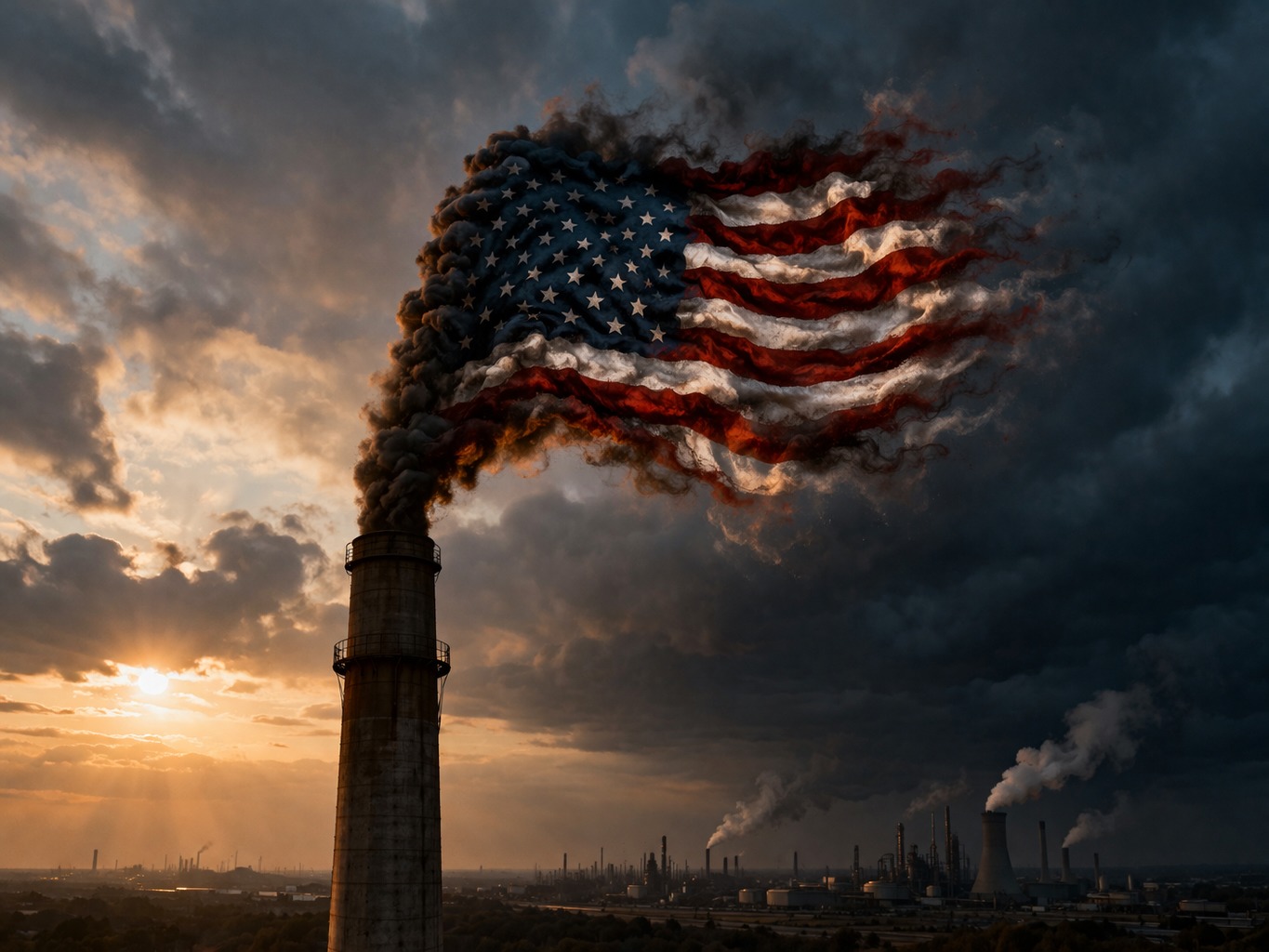
The federal government recently agreed to pay roughly $1 billion to TotalEnergies to abandon offshore wind projects in U.S. waters. Those projects were expected to power more than a million homes. Instead, that capital is being redirected into dirtier, less sustainable oil and gas development. This is not deregulation. It is a deliberate, taxpayer-funded intervention to halt one form of domestic energy production in favor of another.
That alone should give pause. But it doesn’t stand alone. It’s part of a pattern—across energy, science, public health, civil rights, and institutional governance—that suggests the country is pulling away from the very foundations that built its strength. And not by accident.
Science and Research
Energy decisions make headlines. Science policy rarely does. But the consequences of underfunding it outlast any news cycle.
For decades, American leadership has been built on sustained investment in research through institutions like the National Institutes of Health and the National Science Foundation, investments that produced the breakthroughs defining modern life, from cancer therapies to semiconductors. Recent funding constraints and disruptions are already affecting research pipelines. Universities are scaling back. Grants are stalled. Researchers are reconsidering where to build their careers.
This isn’t theoretical. It’s arithmetic: slow the investment, slow the innovation, lose the ground. China has spent years building out its research capacity. The EU keeps deepening collaborative funding. The U.S. doesn’t need to outspend them. But walking away from the table is a different thing entirely.
Public Health
The costs in public health are the most immediate. The United States spent decades creating a system capable of responding to outbreaks, developing vaccines, and protecting population health. It took a long time to build. It’s taking a far shorter amount of time to break.
Recent shifts in vaccine policy and public health messaging are accelerating that erosion. Growing political interference in agencies like HHS, combined with amplified skepticism toward vaccines despite overwhelming scientific consensus, is undermining the institutional confidence that makes public health systems work. Vaccines are one of the most effective tools medicine has ever produced, and the trust behind them took generations to earn.
Eroding confidence in that system doesn’t create freedom. It creates a specific kind of vulnerability—the kind that shows up as outbreaks, as misinformation taking hold, as people dying from diseases we know how to prevent. And once that trust is gone, it doesn’t come back easily.
Environmental Policy
Not every regulation is worth keeping. Some rules are outdated, some are redundant, and a serious case can be made for trimming them. But that’s a different argument from what’s actually happening.
Efforts to weaken water protections, emissions standards, and pollutant tracking may reduce compliance costs in the short term. But many of these protections were established after costly failures: industrial contamination, unsafe air, widespread health consequences. Rolling them back doesn’t eliminate risk. It shifts it onto communities and future taxpayers. When guardrails are removed, the consequences tend to arrive later and cost more.
Voting Rights and the Press
A country’s strength depends on whether people trust the system that governs them. The proposed SAVE Act would require documentary proof of citizenship to register to vote. Noncitizen voting is already exceedingly rare, yet millions of eligible Americans lack ready access to such documentation—rural voters, lower-income individuals, many married women whose legal names differ from their birth certificates. When barriers rise, access falls. Policies that reverse the trajectory toward broader participation reshape who governs and who does not.
The same pressure is bearing down on the press. The First Amendment isn’t an abstraction—it’s the mechanism by which power gets scrutinized, challenged, and held to account. When the government threatens broadcast licenses, targets specific media organizations through regulatory pressure, and repeatedly labels journalists as enemies of the state, the effect is a press that pulls its punches. A country without independent journalism doesn’t become more stable. It becomes less informed, and more easily misled.
The Pattern
Each of these areas can be debated individually. But taken together, they point in the same direction: away from investment in the future, away from scientific expertise, away from broad democratic participation, and away from the independent institutions that hold power accountable. That is not a neutral shift. It is a deliberate one.
And because these systems are connected, the damage doesn’t stay in one place. Weaker research means slower medical breakthroughs and fewer competitive industries. A less trusted public health system means a less healthy, less productive workforce. And when people stop trusting institutions, the effects are harder to trace but impossible to ignore.
It’s tempting to view these developments as inevitable, as if they’re simply the product of forces too large to name or change. They’re not. They are the result of decisions made by elected officials, supported by voters, and enabled by disengagement.
Many Americans supporting these policies are doing so in good faith, responding to legitimate concerns about economic security and eroding trust in government. But good intentions don’t guarantee good outcomes. In practice, these policies often work against the very interests they claim to serve—gutting research slows the medical breakthroughs that save lives, weakening public health infrastructure puts families at greater risk, and turning away from future industries shrinks the economy those families depend on.
This isn’t really about left or right. It’s about whether the choices being made actually serve the people they’re supposed to serve.
The United States is not in irreversible decline. It remains one of the most dynamic and capable countries in the world. But direction matters.
Spending $1 billion to shut down offshore wind development is not the defining policy of this era. But it’s a clear signal of what the priorities are—and those priorities reach well beyond energy. Countries don’t usually fall behind all at once. They do it gradually, through decisions that each seem defensible on their own but add up to something much harder to reverse.
That process can be reversed. But it won’t reverse itself. It takes attention and engagement—and if left unaddressed, it can last for a generation.

