


Connecticut’s Response to Opioid Epidemic
In June, Attorney General William Tong announced Connecticut would receive up to $64 million over eight years from the settlement with Purdue Pharma and its owners, the Sackler family. This is part of a $7.4 billion settlement resolving lawsuits over their role in the opioid epidemic. This is a significant increase from previous settlement attempts that will provide resources for addiction treatment, prevention, and recovery efforts.
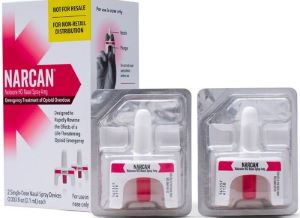
In Connecticut, the Department of Mental Health and Addiction Services (DMHAS) tracks opioid overdoses and prevention through the Nalaxone (also known as NARCAN ® Nasal Spray) Initiative, working closely with Regional Behavioral Health Action Organizations (RBHAOs).
Nalaxone is a lifesaving prescription medication whose only use is to reverse the overdose of an opioid (heroin, OxyContin, Vicodin, fentanyl, etc.). It is a safe and easy-to-use medication that you can get from your doctor or a certified pharmacist. CT Medicaid and most commercial insurance companies cover Nalaxone, although there may be a co-pay or deductible. Persons dependent on opioids who are given Nalaxone will experience opioid withdrawal. In any overdose situation, 9-1-1 should be called and Nalaxone should be administered if opioids are involved, or suspected to have been involved. Connecticut has distributed close to 60,000 Nalaxone kits, exceeding the state saturation goal for the year.
PROJECT: OPIOID AWARENESS
General Assembly Proposed Bill No. 476
An Act Declaring Opioid and Substance Use Disorders a Public Health Crisis, and Establishing a Commission on Opioid and Substance Use Disorder
In response to the expected funds to treat opioid addiction treatment and prevention, including recovery and mental health issues, one of Connecticut’s strongest advocates for identifying and treating opioid addiction is State Senator Saud Anwar, Deputy President Pro Tempore. Senator Anwar, a physician specializing in Lung Diseases and Critical Care Medicine, introduced legislation to address what the Center For Disease Control and Prevention (CDC) labels as an opioid overdose epidemic.
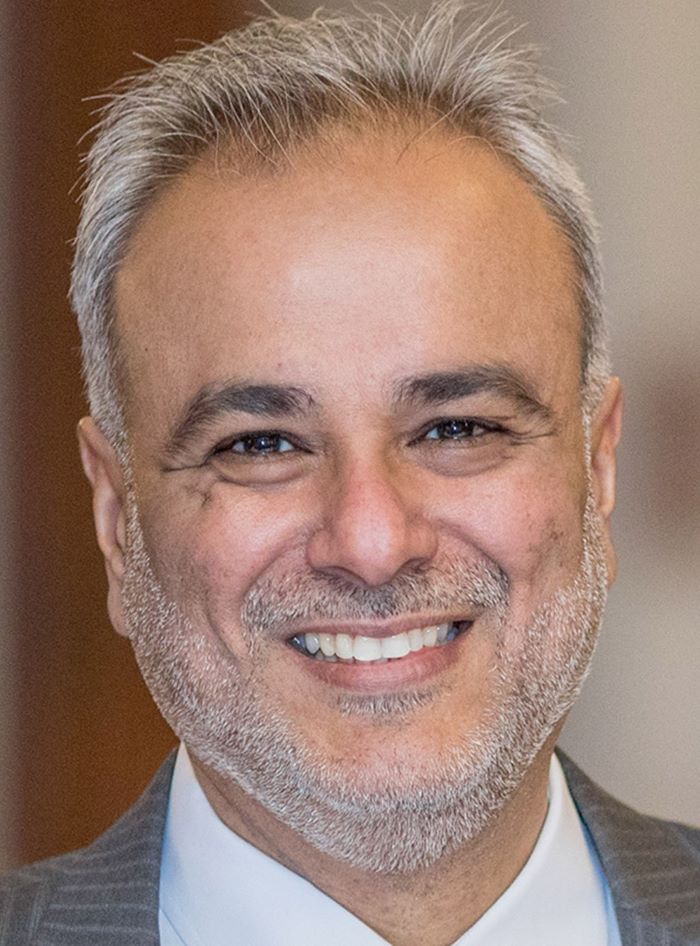
In an interview with the Stratford Crier, Senator Anwar noted that he has been keeping track of the number of lives lost to overdoses in Connecticut — what he calls “the human cost of wrong action.”
”The proposed bill, General Assembly Proposed Bill No. 476, aims to address the growing concern of opioid and substance use disorders by officially declaring them a public health crisis,” Anwar says. The intention of the bill is to raise awareness and resources to fight the issues more effectively, and to create a commission focused on coordinating responses to opioid and substance abuse disorders.
“The bill introduces new legal language to amend the general statutes to reflect these changes,” he says, “although it does not specify any deletions from current law.”
Anwar says that Gov. Ned Lamont pushed lawmakers to remove from the bill a provision to establish overdose prevention centers throughout the state. “On May 29th, 2025, the Overdose Prevention Center part was removed from SB 7 because of a veto threat by Governor Ned Lamont.” Anwar claims that since then there have been 789 overdoses, and 83 deaths.
“This was not just a wrong policy decision made by the Governor,” he says. “It has consequences.”
Anwar said that overdose prevention centers have been recognized by the entire prevention science community as an effective way of reducing overdose deaths.
What happened to SB 7? The Senate on May 22nd passed SB 7 in a 25-10 vote, paving the way for the state to introduce a pilot program supporting overdose prevention centers. The pilot program would have developed four centers across the state in 2026, according to Senate Democrats. Anwar noted that the centers would have been in Hartford, New Haven, Bridgeport and New London. These centers would have treated addiction, including having safe injection services (which has been removed from the bill), lifesaving medication (Nalaxone), mental health treatment, and public education.
Are overdoses decreasing in the state? In June, Governor Lamont issued a public relations release where he announced preliminary figures from the Connecticut Department of Public Health (DPH) showing a 26% decline in overdose deaths in 2024 compared to those in 2023.
“Let there be no doubt, the opioid crisis remains a very serious public health issue,” Governor Lamont said. “The 990 individuals we lost in 2024 to overdose is far too many of our family, friends, and loved ones to take a victory lap or celebrate when there is still so much more work to do. But, we can be heartened that the data is moving in the right direction, with three consecutive years of fewer deaths due to the robust efforts taken to saturate the state with Nalaxone and train the community on its lifesaving administration, as well as enhance public awareness of the risks associated with drugs like fentanyl. We are at a critical inflection point in this crisis and I have confidence that the investments being made by the Opioid Settlement Advisory Committee and state and federal resources will continue to reduce deaths and provide a path to treatment and recovery supports.”
Connecticut Department of Mental Health and Addiction Services Commissioner Nancy Navarretta said, “Connecticut has demonstrated a clear commitment to reducing overdose deaths, and increasing access to harm reduction, treatment, and recovery supports. By adopting and implementing a statewide Nalaxone saturation plan with our partners, we have been able to make life-saving tools available at no cost across the state and we see the results in a third consecutive year of decreases in fatal overdoses. With the increased availability to medication for opioid use disorder and expansions to the service array through settlement dollars, it is our mission to continue this trajectory.”
At DMHAS, the Opioid Services Division manages projects and initiatives that resulted from infusion of State Opioid Response grant funding, as well as those approved by the Opioid Settlement Advisory Committee. Their suggested improvements were included in SB 7. New titles, same idea: adding three and continuing to support original Harm Reduction Centers in municipalities with highest morbidity rates: Hartford, Waterbury, New Haven, and New London.
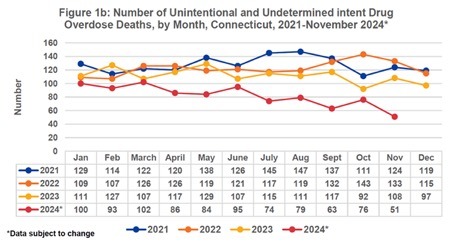
Chart Connecticut Department of Public Health
Anwar cited a discrepancy in the state’s overdose numbers for 2024, in which DPH estimated that 1,118 people died from overdose deaths. He cited a press release from the governor’s office in June of 2025, which showed that 990 individuals died from overdose deaths in 2024, questioning what happened to the 128 deaths. “I find it interesting that we are changing the projections of the past,” Anwar said.
Editor’s note, per AI information: There are some reports estimating that 1,118 people died from fatal opioid overdoses in Connecticut in 2024, based on annualized estimates. This was a predicted 16% decrease from the previous year. However, it is important to note that the number of overdose-related deaths for the latter part of 2024, specifically December, were still pending finalization due to cases awaiting toxicology results at the time the report was compiled.
Additional information on Opioid and Addiction is available on:
- DMHAS Opioid Services Division website at portal.ct.gov/dmhas/programs-and-services/opioid-treatment/opioid-services
- For Zoom Nalaxone 1-hour trainings schedule a date to participate at Catalyst CT. https://catalystct.org/the-hub/
- Anyone seeking services regarding opioid use disorder in Connecticut should visit www.liveloud.org or call 1-800-563-4086 any time, day or night.
Sources: Attorney General Tong and ABC News; State Senator Saud Anwar, CT 3rd District; CT Department of Mental Health and Addiction Services; Governor Ned Lamont June Public Relations release; Connecticut Department of Public Health

