


A common thread weaving nearly all the good in my life is women recognizing something in me I don’t yet have the words to understand and nurturing it. During my final year at UConn, I could not decide which courses to take; I completed all degree requirements and found myself spoiled with too many options. My academic advisor, a woman, reminded me of my hope to take a writing workshop with Professor Barreca, pointing out how her sincerity, standards, wit, and connections could be beneficial to me.
From the first time I heard her name, I was fascinated by the extreme reactions students had to Professor Barreca – either they couldn’t get enough or couldn’t believe they missed the window to drop her class. My initial intimidation soon gave way to respect and admiration, and despite the amount of work assigned weekly, I looked forward to our Wednesday afternoons. Good was not good enough; she pushed, hard, and I was grateful for her pressure. Her dedication to the craft rekindled the passion I hadn’t realized was dying out as the real world awaited me. Post-graduation crept closer and closer.
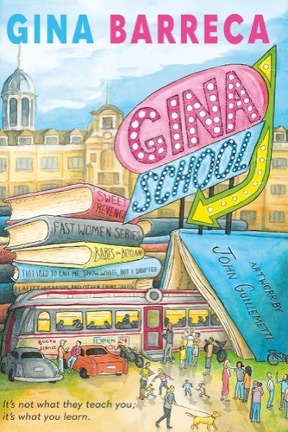
Gina School is Barreca’s latest book, and her summary states: “whether you’re an anxious applicant, a lifelong learner, a book club rebel, or simply someone looking for a little reassurance and a lot of inspiration – you belong here.” I resonate with the latter; struggling to make a dying dream real can feel very isolating, alongside refusing to bend to relentless romantic and gendered expectations. I’m proud of my self-reliance, but am learning that craving support is natural, necessary even.
Each page of Gina School has one piece of wisdom ranging from a single sentence to a short paragraph, making it a quick and relatively easy read. I eagerly read, then re-read, this book, relishing in the subtle shifts in my mind or heart that made room for grace, forgiveness, or hope. Illustrations by John Guillemette, one of Barreca’s former students, add a wondrous dimension and ask the reader to consider the connections between her words and his detailed black and white sketches.
I know Gina would want me to be honest, and honestly, it still feels strange to refer to her by her first name, even though she has insisted I do so more than once. I read her book at work, and work for me, currently, is substitute teaching at any given public school in Bridgeport or Stratford. I could not ignore the irony of flipping through a bound life curriculum, written by a woman who understands the value of living with your head up and eyes open in institutions where students are encouraged to keep their heads down and behind a screen. While reading Gina School, I was confronted not only with my luck in surviving, somehow thriving, in a school system that is failing and insufficient, but in how simple everything could be if we can manage to get, and keep, our priorities straight.
As I mentioned, support is essential, but that support must be carefully selected. I read Gina School and am writing this review during Women’s History Month, purposefully, because what better time is there to look to art and scholarship by us girls. This book’s nineteenth lesson stuck with me, specifically because it acknowledges the “unacknowledged and profound” forces our hidden selves exert on us every day. As Barreca puts it, “[she] is not quite a duplicate, maybe our self from another life.” I’ve encountered this concept a few times now – that women have a secret-self stashed away – and as I’m growing, I find it more and more irresistible. I want to meet my other self, and not in some supernatural doppelgänger way, like Us or Vampire Diaries. I want to look her in the eye when I stand before a mirror. I want to free her, let her be everything women before me could not. I want her to slouch, eat, dance, scream, weep, and curse. And I hope more of us feel compelled to do the same – to relax in our bodies and allow our existence to define what femininity is, and has always been.
Alongside womanhood, Gina School is full of insights on aging, friendship, family, education, work, labor, gender norms, and love. Many of her sentiments turned my drifting ideas into clear notions. They gave me permission I did not know I was waiting for, to evaluate the role I, and others, play in it. A handful of her statements sparked the beginnings of new trains of thought, some of which I can’t yet follow. What comes to mind are lessons fifty, seventy-three, and ninety-four (get the book so we can chat about these). I trust time and a fully developed frontal cortex will make up for my naïvety, and I look forward to revisiting this with more experienced eyes.
You could argue this is a book full of truisms, but in my opinion, we need as many people as we can get reminding us that this life is nowhere near as complicated or singular as we pretend it is. I’d happily live in a world where Gina School was a real place; we are in desperate need of compassion, tolerance, and guts, coupled with a healthy dose of general dissatisfaction. If you’re interested, and I hope you are, click here to purchase a copy, and please let me know what you think.
Pascale is a young Haitian-American writer with aspirations of sustaining herself by giving the written word the attention it deserves. Her top priority is freeing herself from student debt, but she keeps the dream alive by reading often and participating in her community writing group. Feel free to connect with her via email at pjoachim255@gmail.com.


