


What is Pride Month?
“Say it loud, gay is proud.”
Source: History.com, Library of Congress, Wikipedia
By Barbara Heimlich
Editor
LGBTQ Pride Month 2022 in the United States began on Wednesday June 1st and ends on Thursday, June 30th.
What does LGBTQ stand for?
LGBTQ stands for Lesbian, Gay, Bisexual, Transgender and Queer (LGBTQ).
Why is there a Pride month?
Pride Month celebrated each year in the month of June to honor the 1969 Stonewall Uprising in Manhattan. The Stonewall Uprising was a tipping point for the Gay Liberation Movement in the United States. In the United States the last Sunday in June was initially celebrated as “Gay Pride Day,” but the actual day was flexible. In major cities across the nation the “day” soon grew to encompass a month-long series of events.
What was the Stonewall Uprising in Manhattan?
The Stonewall Riots, also called the Stonewall Uprising, began in the early hours of June 28th, 1969, when New York City police raided the Stonewall Inn, a gay club located in Greenwich Village in New York City.
The raid sparked a riot among bar patrons and neighborhood residents as police roughly hauled employees and patrons out of the bar, leading to six days of protests and violent clashes with law enforcement outside the bar on Christopher Street, in neighboring streets and in nearby Christopher Park.
Fed up with constant police harassment and social discrimination, angry patrons and neighborhood residents hung around outside of the bar rather than disperse, becoming increasingly agitated as the events unfolded and people were aggressively manhandled. At one point, an officer hit a lesbian over the head as he forced her into the police van— she shouted to onlookers to act, inciting the crowd to begin throw pennies, bottles, cobblestones and other objects at the police.
Within minutes, a full-blown riot involving hundreds of people began. The police, a few prisoners and a Village Voice writer barricaded themselves in the bar, which the mob attempted to set on fire after breaching the barricade repeatedly.
The fire department and a riot squad were eventually able to douse the flames, rescue those inside Stonewall, and disperse the crowd. But the protests, sometimes involving thousands of people, continued in the area for five more days, flaring up at one point after the Village Voice published its account of the riots.
The Stonewall Riots served as a catalyst for the gay rights movement in the United States and around the world. The 1960s and preceding decades were not welcoming times for lesbian, gay, bisexual and transgender (LGBT) Americans. For instance, solicitation of same-sex relations was illegal in New York City.
LGBT individuals flocked to gay bars and clubs, places of refuge where they could express themselves openly and socialize without worry. However, the New York State Liquor Authority penalized and shut down establishments that served alcohol to known or suspected LGBT individuals, arguing that the mere gathering of homosexuals was “disorderly.”
Thanks to activists’ efforts, these regulations were overturned in 1966, and LGBT patrons could then be served alcohol. Engaging in gay behavior in public (holding hands, kissing or dancing with someone of the same sex) was still illegal, so police harassment of gay bars continued and many bars still operated without liquor licenses—in part because they were owned by the Mafia.
It was an unlikely partnership. but in the 1960s being forced to live on the outskirts of society and the Mafia’s disregard for the law, the two made a profitable, if uneasy, match. Where the law saw deviance, however, the Mafia saw a golden business opportunity.
A member of the Genovese family, Tony Lauria, a.k.a. “Fat Tony,” purchased the Stonewall Inn in 1966 and transformed it from a bar and restaurant that attracted straight clientele into a gay bar and nightclub. Run on the cheap, Stonewall was known for being both dirty and dangerous: It operated without running water behind the bar, glasses were “cleaned” by being dunked in tubs of dirty water, and toilets regularly overflowed. The club also lacked a fire or emergency exit.
Despite its less-than-ideal conditions, Stonewall quickly became a popular destination in the gay community—even something of an institution. It was the only place where gay people could openly dance close together, and for relatively little money, drag queens (who received a bitter reception at other bars), runaways, homeless LGBT youths and others could be off the streets as long as the bar was open.
Some scholars have argued the infamous Stonewall riots that sparked the nationwide LGBT movement were as much a resistance against the mob’s exploitation of the gay community as they were a struggle against police harassment and discriminatory laws. Indeed, a handwritten message in chalk on a boarded-up window of the Stonewall Inn after the 1969 riots read, “Gay Prohibition Corupt$ Cop$ Feed$ Mafia.” Two of the main gay-rights organizations that came out of the riots, the Gay Activists Alliance and Gay Liberation Front, actively championed getting organized crime out of gay bars.
Annual LGBTQ+ Pride Traditions
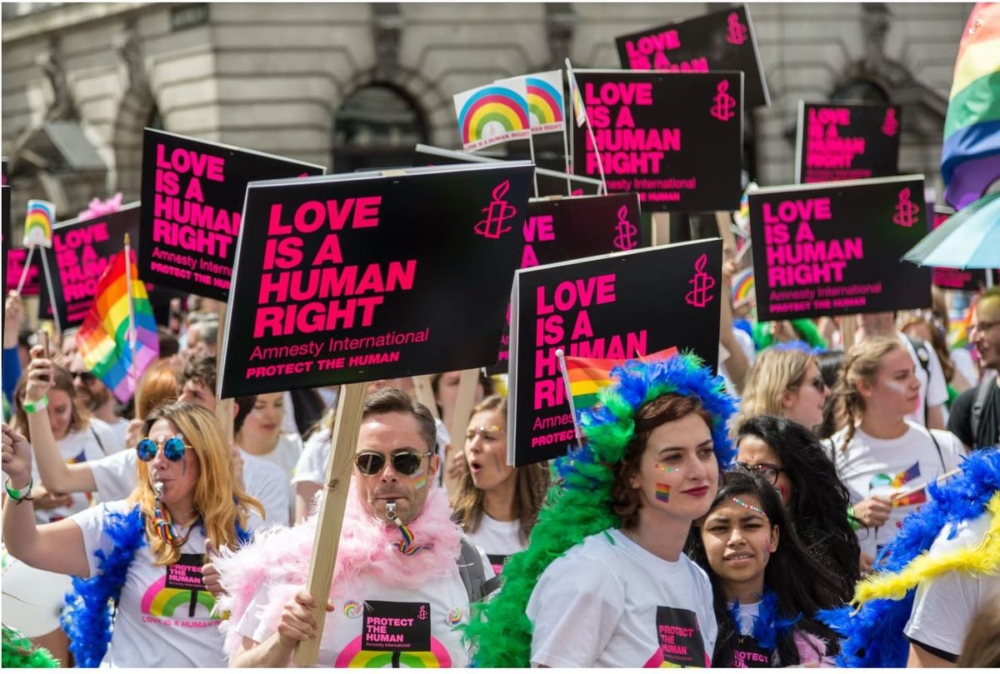
Today, celebrations include pride parades, picnics, parties, workshops, symposia and concerts, and LGBTQ Pride Month events attract millions of participants around the world
Memorials are held during this month for those members of the community who have been lost to hate crimes or HIV/AIDS. The purpose of the commemorative month is to recognize the impact that lesbian, gay, bisexual and transgender individuals have had on history locally, nationally, and internationally.
The first Pride march in New York City was held on June 28th, 1970, on the one-year anniversary of the Stonewall Uprising. The concept behind the initial Pride march came from members of the Eastern Regional Conference of Homophile Organizations (ERCHO), who had been organizing an annual July 4th demonstration (1965-1969) known as the “Reminder Day Pickets,” at Independence Hall in Philadelphia. At the ERCHO Conference in November 1969, the 13 homophile organizations in attendance voted to pass a resolution to organize a national annual demonstration, to be called Christopher Street Liberation Day.
As members of the Mattachine Society of Washington, Frank Kameny and Lilli Vincenz participated in the discussion, planning, and promotion of the first Pride along with activists in New York City and other homophile groups belonging to ERCHO.
By all estimates, there were three to five thousand marchers at the inaugural Pride in New York City, and today marchers in New York City number in the millions. Since 1970, LGBTQ+ people have continued to gather together in June to march with Pride and demonstrate for equal rights.
Has the gay rights movement been successful?
The gay rights movement in the United States has seen huge progress in the last century, and especially the last two decades. Laws prohibiting homosexual activity have been struck down; lesbian, gay, bisexual and transgender individuals can now serve openly in the military. Same-sex couples can now legally get married and adopt children in all 50 states.
It has been a long and bumpy road for gay rights proponents, who are still advocating for employment, housing and transgender rights. The fight for equality has not ended.
Facts about the struggles and milestones of the Gay Rights Movement:
- The first documented U.S. gay rights organization was founded in Chicago in 1924.
Henry Gerber, a German immigrant, founded the Society for Human Rights, the first documented gay rights organization in the United States. During his U.S. Army service in World War I, Gerber was inspired to create his organization by the Scientific-Humanitarian Committee, a “homosexual emancipation” group in Germany.
Gerber’s small group published a few issues of its newsletter “Friendship and Freedom,” the country’s first gay-interest newsletter. Police raids forced the group to disband in 1925. But 90 years later, the U.S. government designated Gerber’s Chicago house a National Historic Landmark.
- The pink triangle was co-opted from the Nazis and reclaimed as a badge of pride. Before the pink triangle became a worldwide symbol of gay power, it was intended as a badge of shame. In Nazi Germany a downward-pointing pink triangle was sewn onto the shirts of gay men in concentration camps—to identify and further dehumanize them.
In 1972, The Men with the Pink Triangle, the first autobiography of a gay concentration camp survivor, was published. The next year, post-war Germany’s first gay rights organization, Homosexuelle Aktion Westberlin (HAW), reclaimed the pink triangle as a symbol of liberation.
- Three years before Stonewall (1966), a protest for gay rights started in another New York City bar. After pouring their drinks, a bartender in Julius’s Bar refuses to serve John Timmins, Dick Leitsch, Craig Rodwell, and Randy Wicker, members of the Mattachine Society who were protesting New York liquor laws that prevented serving gay customers.
These men, members of the Mattachine Society, an early organization dedicated to fighting for gay rights, staged a “sip-in”—a twist on the “sit-in” protests of the 1960s. The trio visited taverns, declared themselves gay, and waited to be turned away so they could sue.
Although the State Liquor Authority initially denied the men’s discrimination claim, the Commission on Human Rights argued that gay individuals had the right to be served in bars. For the next few years in New York, the gay community felt empowered. Police raids became less commonplace and gay bar patrons, while still oppressed in society, had recovered their safe havens.
- Police used a 19th-century masquerade law to arrest people dressed in drag. Many men dressed as women, often referred to as drag queens, were locked up on charges of masquerading and indecent exposure at the National Variety Artists’ Exotic Carnival and Ball held at the Manhattan Center in 1962. Police and detectives herded the costumed guests into police wagons in front of the ball.
In the 1940s, ‘50s and ‘60s, LGBTQ people were regularly arrested for violating what became known as the three-article rule—or the three-piece law. The rule stipulated that a person was required to wear at least three gender-appropriate articles of clothing to avoid arrest for cross-dressing. It was referenced everywhere—including in reports about arrests in Greenwich Village in the weeks and months leading up to the 1969 Stonewall Riots.
The problem is, the law technically never existed.
Instead, accounts suggest that police generally used old, often unrelated laws to target LGBT people. In New York, a law commonly used against the LGBTQ community dates to 1845 and was originally intended to punish rural farmers, who had taken to dressing like Native Americans to fight off tax collectors.
- On the night of the Stonewall Riots, police barricaded themselves inside the bar. After midnight on an unseasonably hot Friday night in 1969, the Stonewall Inn in New York City’s Greenwich Village was packed when police officers entered the bar. As they began making arrests, patrons started to resist and push back.
What ensued was an uprising that would launch a new era of resistance and revolution.
Close to 4 a.m. on June 28th the mob of protestors outside the Stonewall had grown so large and unruly that the original NYPD raiding party retreated into the Stonewall itself and barricaded themselves inside. Some rioters used a parking meter as a battering ram to break through the door; others threw beer bottles, trash and other objects, or made impromptu firebombs.
No one died or was critically injured on the first night of the Stonewall Riots, though a few police officers reported injuries.
- Organizers of the first gay pride parade opted for the “Pride” slogan over “Gay Power.” The Stonewall Riots made clear that the LGBTQ movement needed to be loud and visible to demand change.
Five months after the riots, activists proposed a resolution at the Eastern Regional Conference of Homophile Organizations in Philadelphia that a march be held in New York City to commemorate the one-year anniversary of the raid. Their proposal was for an annual march on the last Saturday in June with “no dress or age regulations.”
When organizers were looking for a slogan for the event, a member of the planning committee, L. Craig Schoonmaker, suggested “Pride.” The idea of “Gay Power” was thrown around as well, but Schoonmaker argued that while gay individuals lacked power, one thing they did have was pride.
The official chant for the march became: “Say it loud, gay is proud.”


Thanks for this VERY ENLIGHTENING history of the LGBTQ movement. All new to me
🤗 🌈