


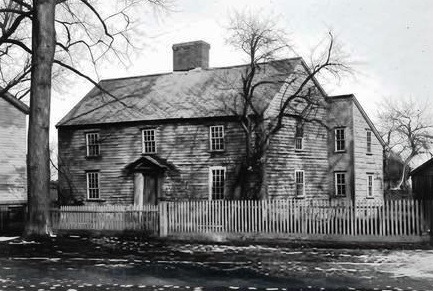
One of the most retold, republished, revised stories in Stratford’s history is Stratford’s “Cinderella Story”: the Glorianna Fulsom/Folsom story. The story is a true one of an unusually beautiful teenage girl named Glorianna Fulsom (or Folsom in many retellings of the story). Glorianna was the daughter of Samuel Fulsom, whose blacksmith shop stood on the corner of West Broad Street and Main Street at the location of what is today known as “William Samuel Johnson” home.
A Scottish baronet by the name of John Stirling arrived in Stratford in 1770, but no one had ever heard of him and he, apparently, came to town under an assumed name. John had either been sent by his father, Alexander the fourth Baronet of Glorat, Stirlingshire, Scotland, or he came to America on his own to establish himself. While John’s motives for coming to America aren’t known, even more mysterious is how he found his way to Stratford. We have to assume, being a member of the Episcopal Church, John sought out Stratford due to the fact that Samuel Johnson, while very old, was still ministering at Christ Episcopal Church. Samuel Johnson founded the first Episcopal Church in Stratford about 1720.
John was smitten by the enchanting Glorianna, and spent the next several months courting her. Since he was an unknown in town, Glorianna’s father, Samuel, was not thrilled with John’s interests in his daughter. After his proposals to Glorianna were rebuffed by her father, John sought the intervention and assistance of William Samuel Johnson, Samuel Johnson’s highly distinguished son.
William Samuel Johnson verified John’s identity through correspondence with John’s royal family in Scotland, then persuaded Samuel Folsom to allow his daughter, Glorianna, to marry the Scottish Baronet. The couple was married in Christ Episcopal Church, March 10, 1771. Due to some unknown family business need, John was called back to Scotland, but didn’t send for Glorianna for a couple of years causing “local tongues to wag”.
Eventually, John sent for Glorianna and their two daughters. She traveled in elegant style back to Scotland from New York City. Glorianna went on to give birth to, depending on which report you read, somewhere between 17 and 21 children. John became the fifth Baronet of Glorat, Stirlingshire, Scotland after his father’s death in 1791.
As America’s Centennial celebrations began in 1876, Glorianna’s story was told and retold with a decidedly unique twist, conflating Glorianna’s love story with American Revolutionary War spies, suspense, and war stories. Glorianna’s story was first documented by William Samuel Johnson’s great-granddaughter, Lillie Devereux Blake, in Louisiana’s The Bossier Banner, August 31, 1876. From there the story spread throughout the nation, assuming a hue more in line with the nation’s Centennial celebration.
Glorianna’s story has a unique connection to the Revolutionary War. Her husband, John, sailed home to Scotland sometime in 1774. By the time he sent for Glorianna, a couple of years later, the Revolutionary War was well underway. John forbade Glorianna from ever returning to America. Many people have wondered why. Scotland was an ally of Britain’s during the Revolutionary War. Scotland provided soldiers and other supplies to the British during the War. Obviously, John would not have wanted Glorianna, or himself, to appear to be supporting the Patriots during the War. It seems only natural that John would have harbored resentment towards the Colonies before, during, and after the War.
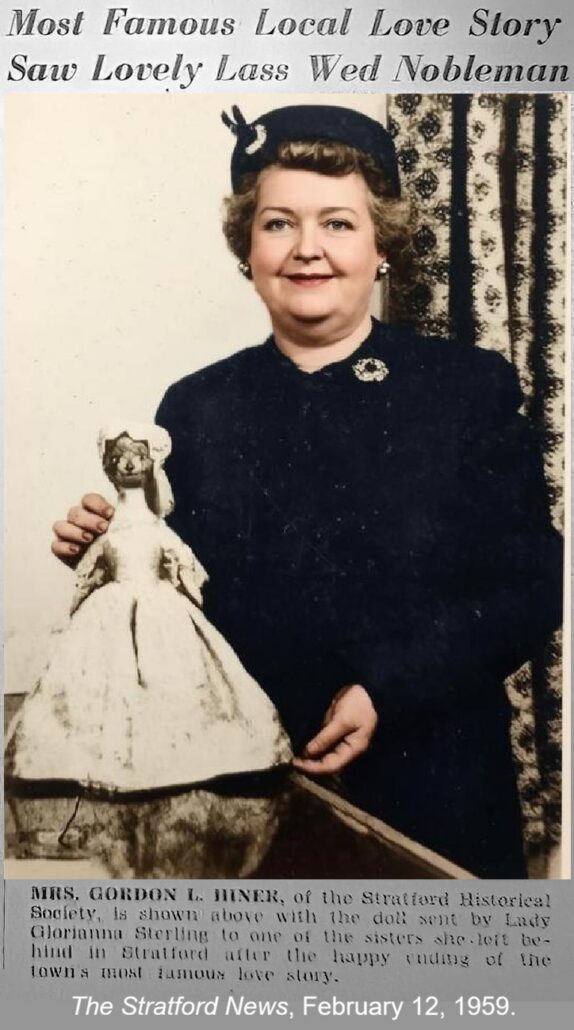
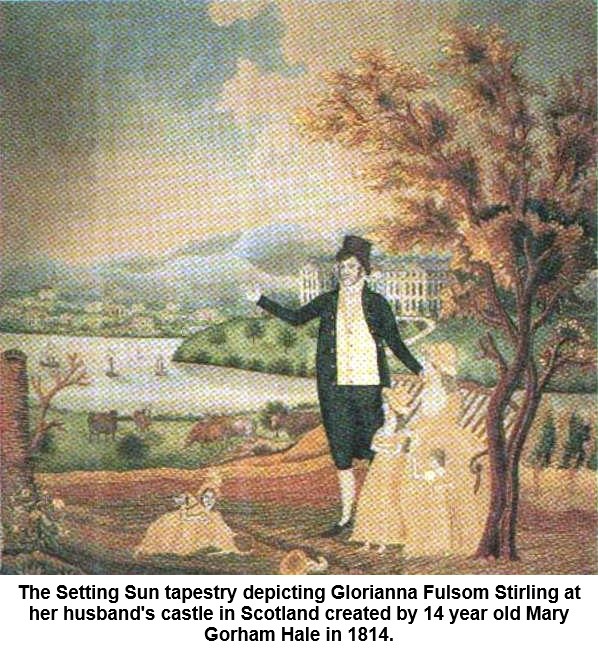
Eventually, Glorianna’s brothers, Nathan and Charles, went to visit her in Scotland. They returned with wonderful tales of the beautiful home she had and the elegant surroundings she enjoyed in Scotland. She sent many beautiful gifts with her brothers for her family and friends in Stratford. Among those gifts was a doll, which eventually found its way to the Stratford Historical Society. The Society also possesses a tapestry created by Stratford’s Mary Gorham Hale in 1814 depicting the young Stirling family.

