


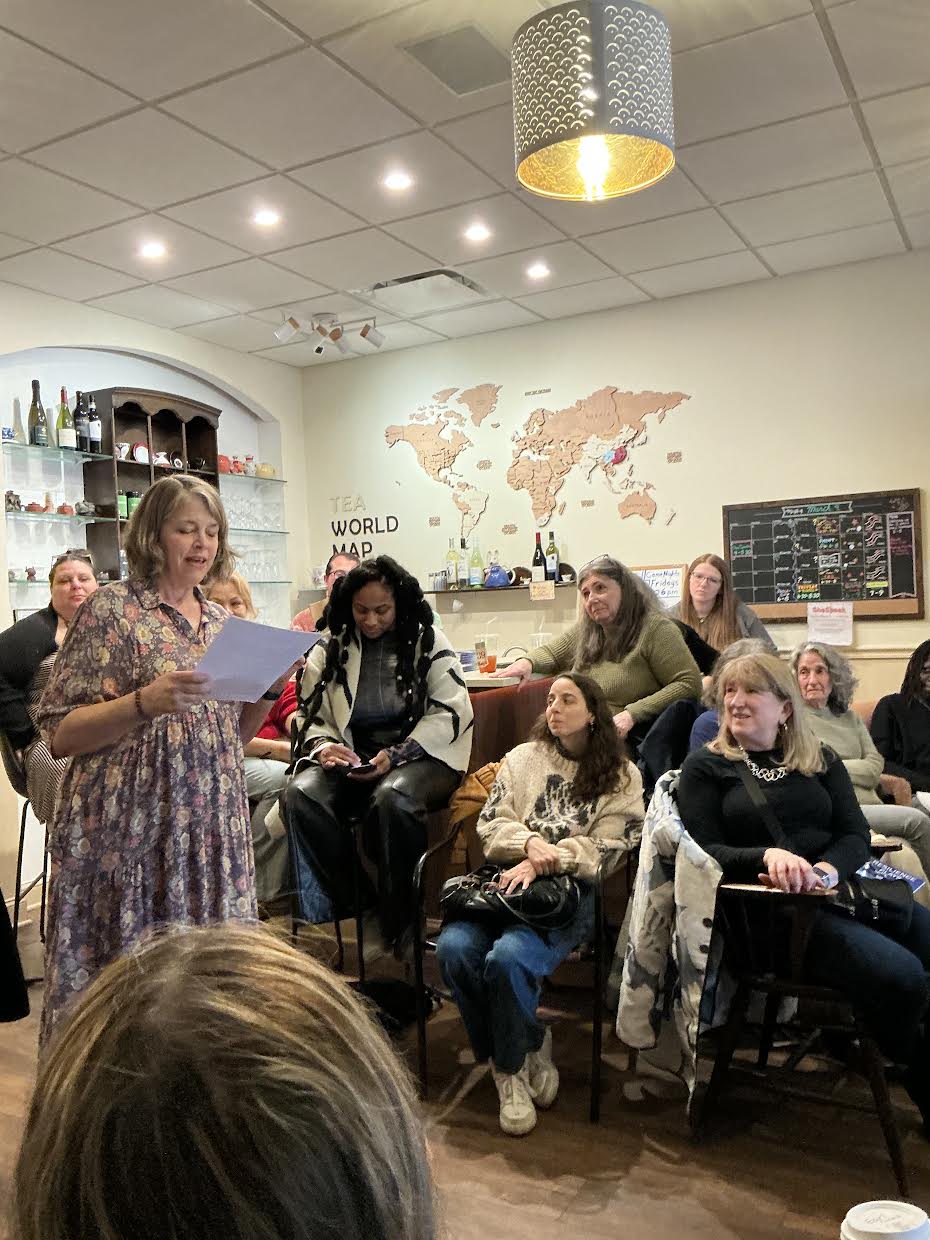
In 2017, a call was made to women playwrights and theater companies to create art, in answer to the rhetoric and policies proposed by then President Donald Trump. Orna Rawls, playwright, and Rachel Babcock, director, responded to the call with SheSpeak, a collection of short plays or stories written by women for women. The writers were members of SquareWrights, a group of Stratford women playwrights.
In an interview with Orna, she said, “The women of SquareWrights rose to the occasion. A program of women’s writing was created within a week and performed to a standing room only audience!” It became a beautiful experience for audience members from Stratford to New Haven.
On a gloomy Sunday just a week ago, forty or so women of all ages (and a handful of men) filled the Oasis Room at Open Door Tea to witness theater in a form I’d never seen before – SheSpeak. The background music of the evening consisted of tinkling teacups and saucers, and the stories in between left me speechless.
But this, this experience sitting amongst women who knew intimately what it feels like to lose yourself only to find yourself again, to question your parenting style, to wonder how baking helps you find your way out of emotional distress, it all felt familiar, and for me, necessary to hear, especially this Women’s History Month.
Mayor Chess honored Orna Rawls at the March Town Council meeting with a proclamation to honor her work within our Stratford community and beyond. In part, he said, “a 53-year resident of our beloved town, a marriage and family therapist, a playwright, and a friend to all.”
One of the wonderful short stories shared on March 8th was written and performed by Norah Christianson, whose poem is below.
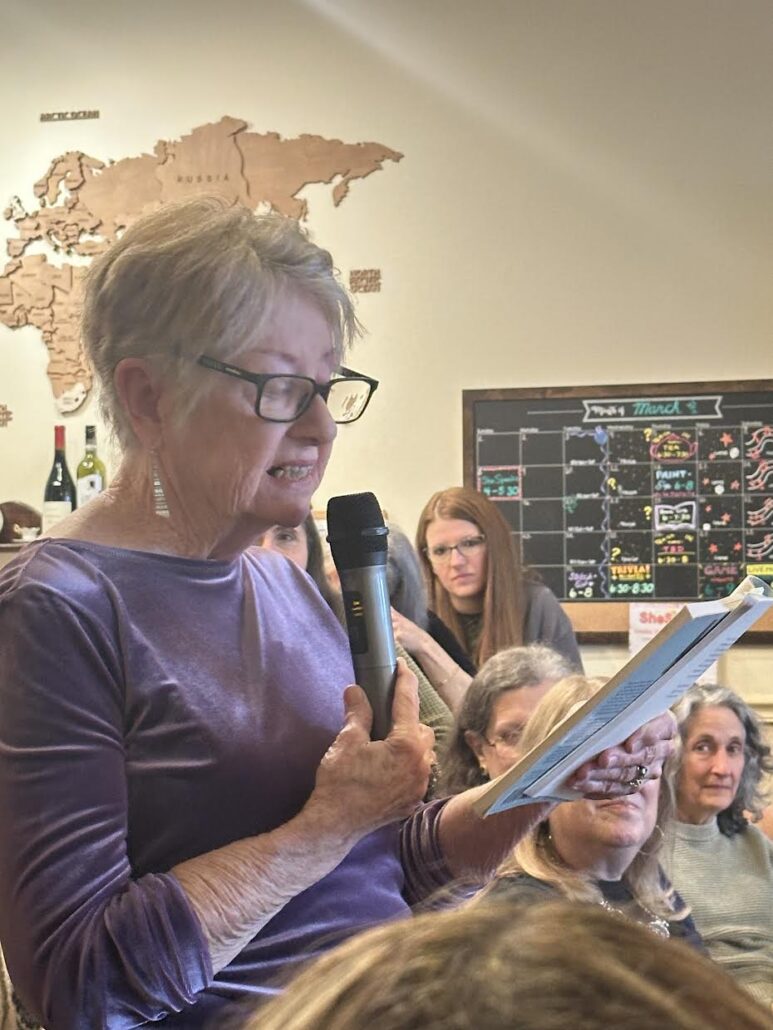
THE GREAT CHICKEN LEG INCIDENT
By Norah Christianson
On his plate, broccoli, smashed potatoes, and
a stricken chicken leg. The boy sits sullen as a possum.
“Why do we always have to have chicken leg?” He asks,
tapping his fork on his plate.
She says, “Eat your dinner,” hard hours spent at work
and the heat of the kitchen in her words.
“Chicken legs are gross,” he seethes. His mother sighs.
While she gazes tiredly around the table for
the salt, he slides his fork tines under the chicken
and hits the handle hard.
The leg flips across the salad, hits the gravy boat and
skids two yards across the linoleum. It leaves a greasy line
like snail’s slime. The boy’s sister sucks in her breath.
No one speaks. The mother rises up, retrieves
the crusty leg, places it with exaggerated carefulness
on his plate, and says low and through her teeth,
“If you ever do that again, I will wipe your face with it.”
She sits as though strung on wires. Savagely butters her bread.
Seven beats. The boy begins to hum “Rhinestone Cowboy.”
He swings his feet. He casually leans on his elbow.
The fork casually inches out, eases under the leg, and
he launches it.
The leg in the air, the leg in the air, the leg arcing, twisting,
pitchpoling, the leg descending, the leg exploding
in the kitty box, litter flying like buckshot.
Then that stillness, as after the lava solidified on Pompeii.
The girl is transfixed. The boy alert, red, jittery, a smile
playing on his face. The mother rises, being a woman of
her word. She pulls the leg out of the clumped litter and
picks the litter off with extravagant delicacy.
And then they’re on the floor. The leg in his ear.
Under the table. The leg down his neck. Oily bits.
Alley oop. Under the chair, greasing his eyes.
Half nelson. Fat gobbets. Hip toss. Down around
the trash bin. The leg under his pants. Tiger driver.
The crusty pimpled chicken leg everywhere at once.
Golden boyhood. Mother eyeflash. Sister pulling
her knees to her chest. Boy half sobbing, but almost
laughing. Mother on the floor, hair in greasy strings,
wielding a chicken leg like a caveman’s club.
It is finished. They stand panting. His hair sticks out
in peaks. He glows with grease-shine and fury.
“Now go and take a shower,” the mother says,
pointing like God.
And does he?
Of course not.
With her last bit of strength she catches him up by his shirt,
pulls and pounds him thrashing, up the stairs,
flings him in the shower like a bag of eels.
Fifteen, twenty, twenty-five minutes, the mother
chewing determinedly the cold green beans and
the girl watching her tensely. The sound of gallons
of water glugging down the pipes in the walls
like the laugh of a loony. Finally the girls says
In a half-whisper, “I don’t think he’s going to come out.”
“No,” says the mother.
She lays down her fork, takes off her apron, lifts
her sweater from the hook, says,”I’ll be walking.”
And out the door.
She stumps along through the field, lungs clenched up,
breathing shallow with anger. Getting up through
the pine grove, then slowing, then wandering along
Shore Road, until she comes to the river.
And does she throw herself in?
Drown herself just thinking of the teenage years ahead?
Of course not.
She takes a long deep drink of the night air. A little curling
smile tugs one side of her mouth. She stands looking out at the
rustling river, seeing not the river but that magnificent
stubbornness, his shining gold-greased self,
that fire in his eye.
She turns home.
-Published with permission of the writer, Norah Christianson


What a splendid story about family love and teenage defiance!