


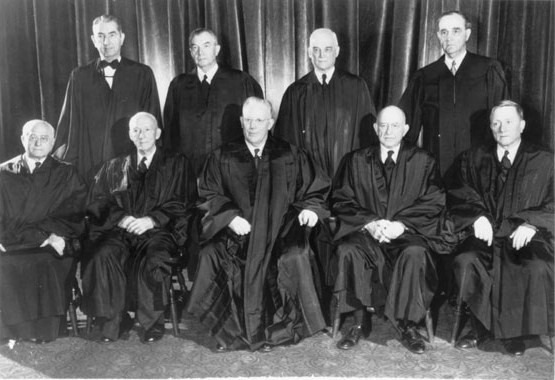
On May 17, 1954, the Supreme Court unanimously decided Brown v. Board of Education, declaring racial segregation in public schools unconstitutional. It remains one of the Court’s most consequential decisions — not because it ended racism, inequality, or resistance to integration, but because it affirmed a principle the country had too often denied: separate is not equal.
The ruling was important enough to inspire a song. “Black and White,” written in 1954 by David I. Arkin and Earl Robinson, later became a major hit for Three Dog Night in 1972. But the group’s version omitted lyrics that directly celebrated the Court’s role:
“Their robes were black, their heads were white,
The schoolhouse doors were closed so tight,
Nine judges all set down their names,
To end the years and years of shame.”
Those lines captured a moment when the Supreme Court exercised its authority to expand freedom and strengthen the promise of equal citizenship. The Court did not solve America’s deepest problems. It did not end segregation on its own. Indeed, the backlash to Brown was fierce, sustained, and often successful. But the decision gave constitutional force to the idea that public institutions could not lawfully degrade children on account of race.
That is what makes today’s contrast so painful.
Instead of building on that legacy, the current Supreme Court’s conservative majority has too often moved in the opposite direction. In Shelby County v. Holder, the Court invalidated a key provision of the Voting Rights Act, opening the door to new voting restrictions in several states. In Dobbs v. Jackson Women’s Health Organization, the Court overturned Roe v. Wade, ending the federal constitutional right to abortion and leaving access subject to state law. Citizens United v. FEC helped unleash more outside money into American politics. Taken together, these decisions reflect not only legal reasoning, but also a broader retreat from the spirit of inclusion and equality that Brown embodied.
The Court has also made it harder to challenge partisan gerrymandering in federal court, limited LGBTQ protections in public accommodations, made it harder to defend gun-safety laws, constrained environmental regulation, and expanded presidential immunity, all of which threaten basic democratic accountability. For example, after Shelby County, Texas and other states quickly implemented strict voter ID laws and reduced polling places, these measures disproportionately affected communities of color.
These are not isolated decisions. Proponents argue that the Court is restoring constitutional limits, protecting individual liberties, and correcting earlier judicial overreach. Critics see something very different: a broader legal and political project that shifts power away from voters, workers, consumers, people seeking health care, marginalized communities, and regulatory agencies — and toward corporations, wealthy interests, religious-liberty claimants, gun-rights advocates, and executive authority.
Reasonable people can disagree about constitutional interpretation. But we should not pretend the Court is merely calling balls and strikes. The judiciary is shaping the nation’s future as surely as Congress and the president. When the Court narrows voting rights, democracy suffers. When regulatory power weakens, public health and the environment suffer. When it removes protections people have relied on for generations, trust in the law suffers.
Brown reminds us that courts can open doors, but also that progress is not inevitable. It must be demanded, defended, and renewed.
The lesson of Brown is not nostalgia. It is a responsibility. I still remember learning about Brown in school, not as a dusty legal milestone, but as proof that American institutions, however flawed, could be pushed toward justice. Progress happens when people organize, vote, litigate, teach, write, march, and refuse to accept injustice as settled law.
Seventy-two years ago, nine justices helped open the schoolhouse doors. Today, democracy requires us to keep them open — not through nostalgia, but through vigilance, voting, and organizing, and by refusing to treat the erosion of rights as normal. The promise of Brown endures only if we defend it together.

