


Each year on Memorial Day Stratford residents gather on Academy Hill to honor and to pay tribute to those valiant men and women who fought, and some who died, fighting for America’s and Stratford’s rights and freedoms. Stratford is unique from most other towns in America, in the respect that it has two memorial greens.
We rarely think of the second memorial green, but it, too, plays an important role in Stratford’s and America’s heroic past. West Broad Green is the site of five memorials that are frequently forgotten. The first is the World War I memorial at the foot of West Broad Street.
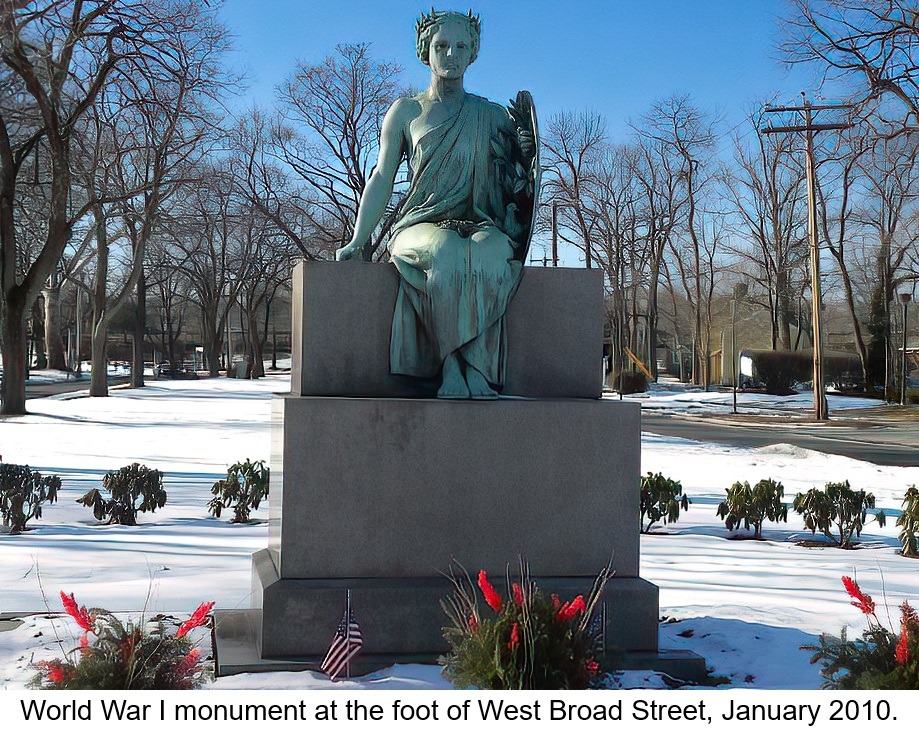
The World War I monument at the foot of West Broad was sculpted by Willard Dryden Paddock and was placed on the green in 1921. It pays tribute to the 630 Stratford men and women who fought in World War I, and to the thirteen of those brave individuals who were killed in action. The bronze statue depicts a woman with a shield on her left arm. A dove is nestled between the inside surface of the shield and her left leg. Originally, she was grasping a sword in her right hand but this was removed by vandals not long after the statue was unveiled.
The face of the shield depicts an eagle in flight, its talons extended, encircled by stars. In the woman’s lap is a pile of stars symbolizing the casualties of the war. At the rear of the monument is a plaque which reads: “In grateful recognition of all those who served our country in time of war, the Town of Stratford dedicates this memorial, A. D. 1921.”
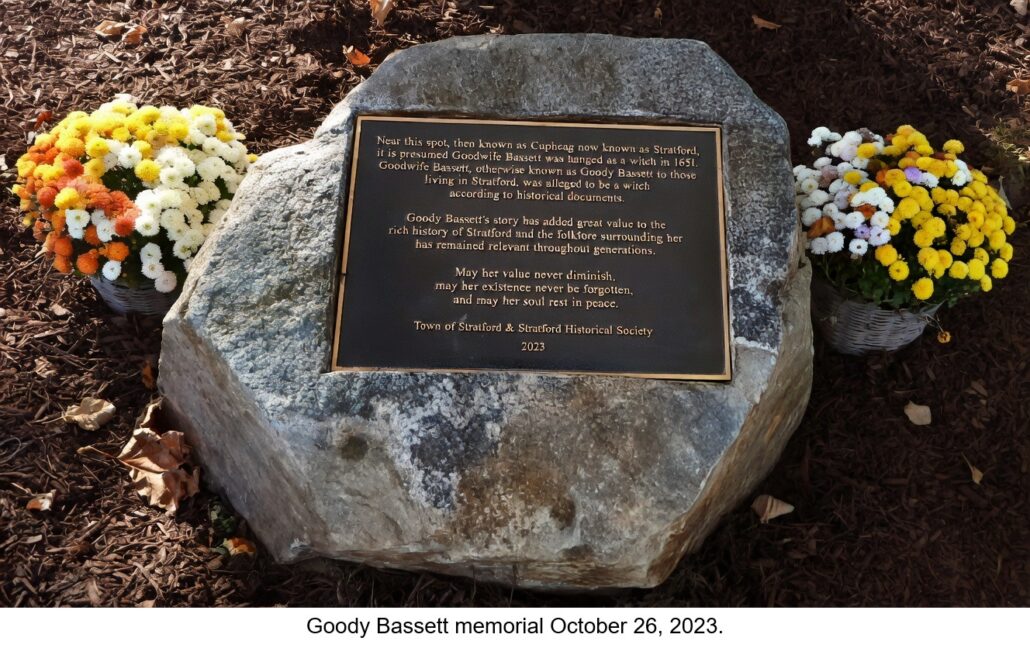
The second memorial is a monument that was placed on the green in October of 2023, directly across from the Perry House. This is a memorial to Goody Bassett, who was hanged for the “crime” of witchcraft in May of 1651. It may seem odd to associate this monument with Memorial Day, but it plays a unique role in Stratford’s fight for equal rights for all men and women. In Trumbull’s official history of Connecticut, written in 1818, the author unequivocally denies that anyone was ever but to death in the Connecticut Colony for the crime of witchcraft. However, Stratford knew that wasn’t true, and never denied that a poor, unfortunate woman had been put to death in Stratford for “witchcraft.”
Rev. Samuel Peters wrote the “unofficial” first history of Connecticut in England in 1783. In Rev. Peters’ history, he indicates that a woman was put to death in Stratford for the crime of witchcraft. In fact, he states that this poor woman was the only person he knew of who had been executed for the “crime” of witchcraft. The Colony of Connecticut had done much to bury the tragic hangings of convicted “witches” because they found these hangings to be embarrassing and not in keeping with how they wanted Connecticut remembered.
But Rev. Peters knew better. He had lived in the Captain William Birdseye home on the corner of Main Street and Birdseye Street for 20 years before the Revolutionary War. Living in town for these several years, he had learned of many Stratford historical events, including the witch trial in Stratford.
Stiles Judson carried the Goody Bassett story forward as a part of Stratford’s 250th anniversary celebration in 1889. He wanted to ensure that the Declaration of Independence guaranteed the rights of all men and all women in America. While Connecticut was still denying that anyone had been executed for practicing witchcraft, Stiles knew better.
Stiles created a “tableau” portraying Goody Bassett during the 250th anniversary’s celebratory events. Stiles was obviously moved by this ill treatment of women in Stratford, symbolized by Goody Bassett’s hanging. He went on to become a champion of women’s rights in Connecticut. Stiles helped found the Men’s Equal Suffrage Association in Connecticut, and worked with his sister, Alice, to found Stratford’s Equal Suffrage Association in 1912.
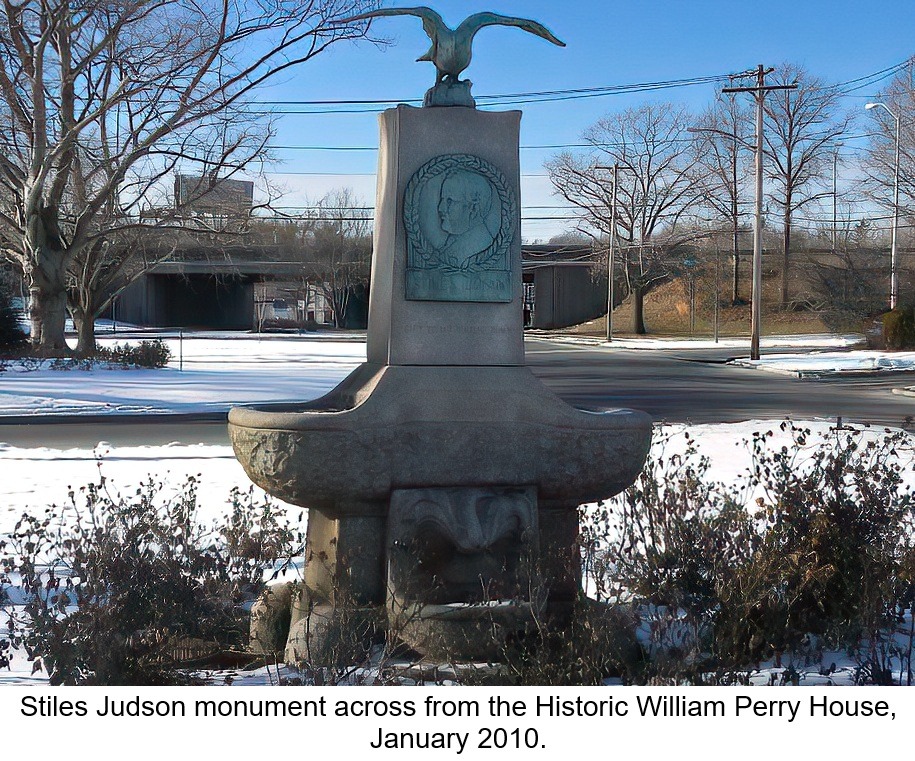
A monument honoring Stiles Judson and his service to Stratford and Connecticut once stood next to the Goody Bassett monument. That monument was destroyed by a truck colliding with it in February of 2024. We’re hopeful that the town can soon repair this monument and return it to its rightful place on West Broad Green.
Our fourth memorial isn’t so much a memorial as it is a long-gone reminder of Stratford’s history. On the corner of West Broad Street and Beardsley Avenue stands the one-time mansion of Bedell Benjamin. His home was built on the site of his grandfather’s Benjamin Tavern. The Benjamin Tavern is a true Revolutionary War site. In this tavern in 1779, General Washington and General Lafayette met for the first time. The two generals no doubt had much to discuss as the Colonies were doing very poorly fighting the British forces in 1779.
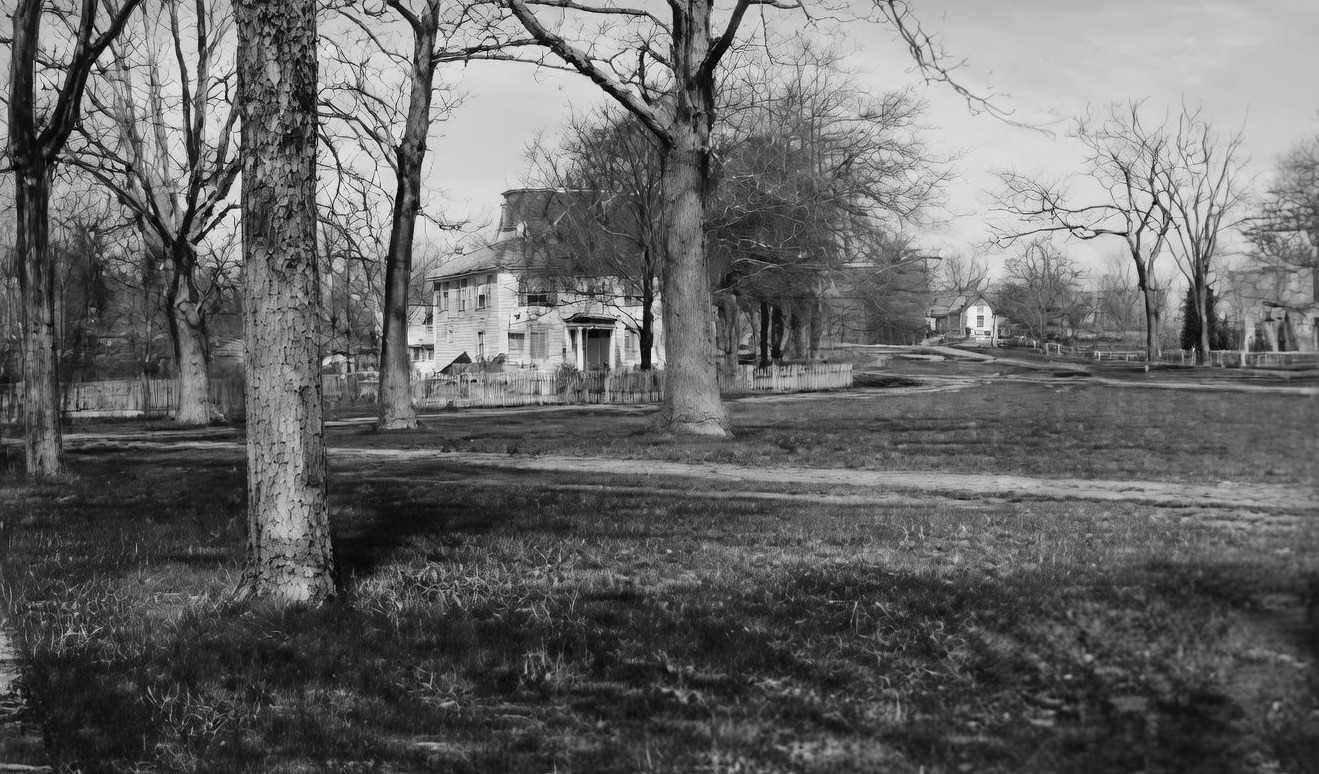
While we know of no existing pictures of the Benjamin Tavern, we have included a photo taken by Bedell Benjamin about 1900 from his front lawn looking across West Broad to the Philip Benjamin home standing to the west of today’s William Perry house.
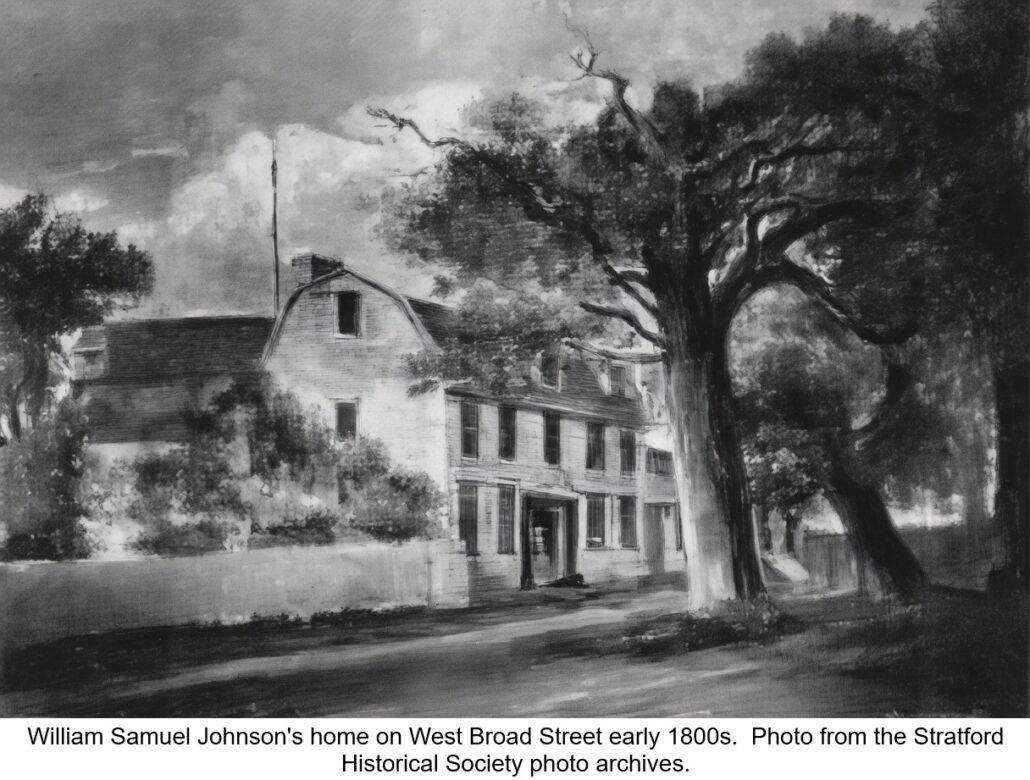
Lastly, our fifth monument is also not a monument but another long-gone reminder of Stratford’s role in founding America. It is the site of what once was William Samuel Johnson’s home at about 1087 West Broad. We realize most people believe William Samuel Johnson’s home is on the southwest corner of Main Street and West Broad. However, while William Samuel Johnson had the home built for his son, Samuel William Johnson, William never lived there. He spent a good share of his life at his home on West Broad Street.
William Samuel Johnson represents so much of what America endured leading up to, during, and following the Revolutionary War. He remained neutral throughout the war, and was imprisoned in Farmington, Connecticut, due to the fears of the Patriots that Johnson would reach out to the British during the war and try to influence the war’s outcome. He never would have done that, though many of the citizens of town pleaded with Johnson to negotiate with General Tryon not to burn Stratford as he had Fairfield. Johnson did not approach the British to plead for the safety of Stratford. Nevertheless, the Patriots knew of Johnson’s great knowledge of the British and did not trust him.
Johnson went on to become one of the editors and signers of the U. S. Constitution, Connecticut’s first United States Senator, and the first President of Columbia College (today’s Columbia University).
Perhaps as you pass by West Broad on Memorial Day, you’ll consider the role Stratford’s other “memorial green” played in Stratford’s and America’s history.

