


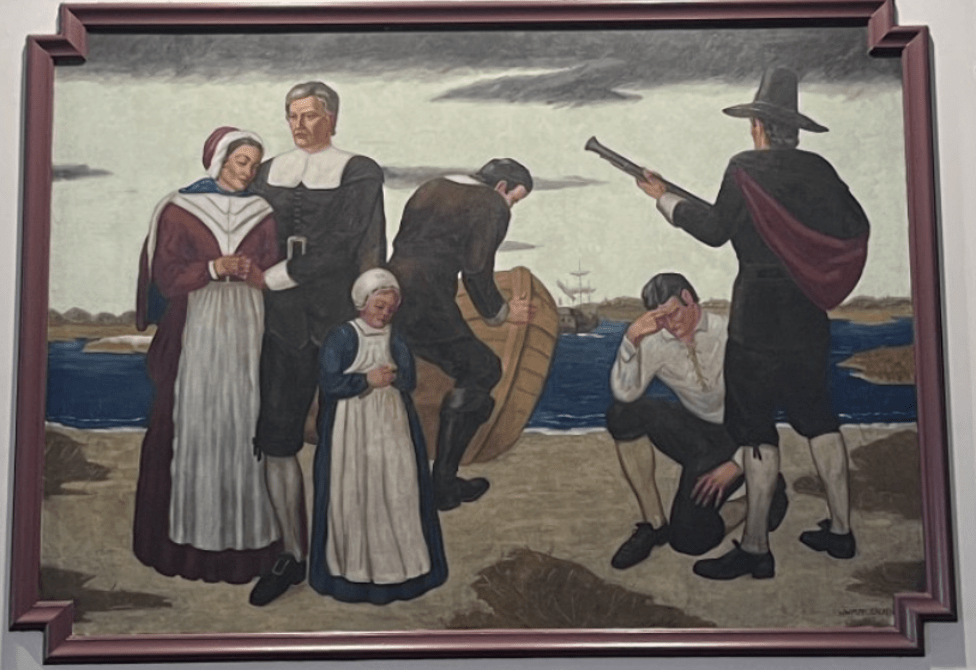
For the past two months, I’ve been sitting at the center of the Town Council chamber, looking out at colleagues, residents, and neighbors as we debate the business of Stratford. And behind us, watching over every vote, is the painting “Arrival of the Founders” created by William McCracken for the opening of Stratford’s “new” Town Hall in 1937.
I found myself curious about it. Where did it come from? What story was it telling?
It was painted in the 1930s as a Works Progress Administration (WPA) funded project and depicts Stratford’s first settlers arriving by ship at Mac’s Harbor. That’s what people believed at the time. But history has filled in the gaps. The settlers traveled overland on Native American trails from Wethersfield. The story we see on the wall is not the full story.
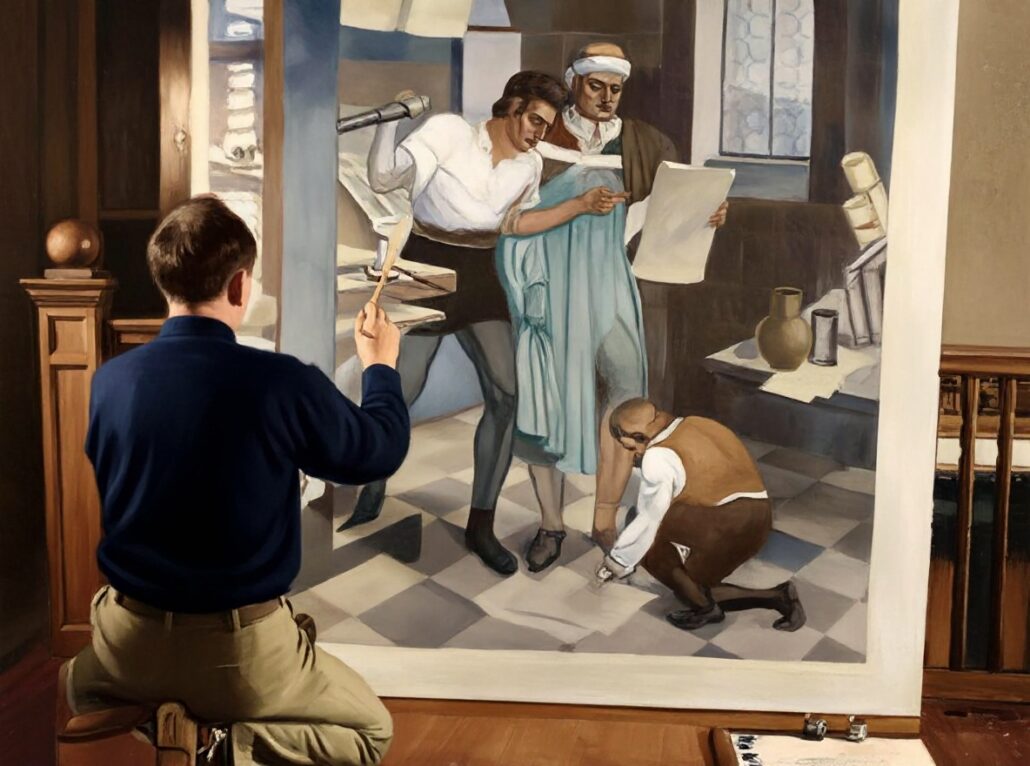
The painting is part of our civic history. It was created at a moment when federal public art programs sought to instill pride and cohesion during the Great Depression. It remains a historical artifact not only of Stratford’s 17th-century founding, but of 20th century interpretation.
That matters.
The images we place in our civic spaces are not just decoration. They are statements about who we believe we are. When something hangs in the chamber where laws are debated and decisions are made, it becomes part of our public identity.
Stratford in 2026 is not Stratford in 1937. We understand more now about the Indigenous presence before colonial settlement, about the layers of migration that followed, about the many hands and histories that built this town.
This isn’t about tearing down the past. It’s about telling it more honestly. It’s about asking whether the central image in our chamber reflects the truest essence of Stratford or just a fragment of it.
Maybe it’s time to imagine a new community portrait. One that acknowledges the Native trails before the harbor. One that honors our maritime roots, our working waterfront, our schools, our neighborhoods, the generations who came long after 1639 and made this place their own.
If we are going to hang our story on the walls of Town Hall, it should be a story big enough to hold all of us.
Anthony Afriyie serves as Chair of the Stratford Town Council.


Anthony — Thank you for writing this, asking these questions; calling for a full picture of our long local history. There’s a powerful possibility here for public education, dialogue and creative collaboration and I am eager to see this take shape.
Don’t forget to include the execution of Goody Bassett in 1651 for witchcraft.