


The Merriam-Webster Dictionary defines a legend as “a traditional story sometimes popularly regarded as historical but not authenticated.” Over Stratford Town’s 387-year existence, some 600 legends have been recorded. It appears we are bound to add one more to this collection.
Writing in his 1989 Stratford history, In Pursuit of Paradise, Lewis Knapp wrote: [Benjamin] “Franklin was appointed Deputy Postmaster General in 1753, and immediately commenced improving the system. It was a peculiar parade that appeared over the crest of Clapboard Hill that summer and creaked its way down toward the parade ground. In a chaise of his own design, Franklin led a group of carts loaded with large stones. Halfway down the hill, a curious homemade odometer geared to a wheel of the carriage registered another mile. The wagons halted and the workmen rolled a huge stone out of one of the carts, and planted it, upright, in the ground. Later ‘NY72’ was carved on one side and ‘NH15’ on the other. The milestones served to verify postal rates and inform travelers; they also gave the Kings Highway official status.
At the bottom of the hill, Franklin must have stopped to visit Doctor Samuel Johnson, who two years before had been his choice for president of the college in Philadelphia.”
I read In Pursuit of Paradise shortly after Mr. Knapp published it. Those two paragraphs jelled and have stayed with me ever since. I’ve related his Benjamin Franklin story over and over and, most recently, shared it with Mayor Chess and the Town Council in the July Town Council Public Forum. I was pleading with the Council to please provide protection for the postal marker Franklin, allegedly, placed on Ferry Boulevard in 1753.
There are two other histories of Stratford that I read after I had read In Pursuit of Paradise. They are William Howard Wilcoxson’s History of Stratford 1639 to 1939, and Rev. Samuel Orcutt’s A History of the Old Town of Stratford Vol I.
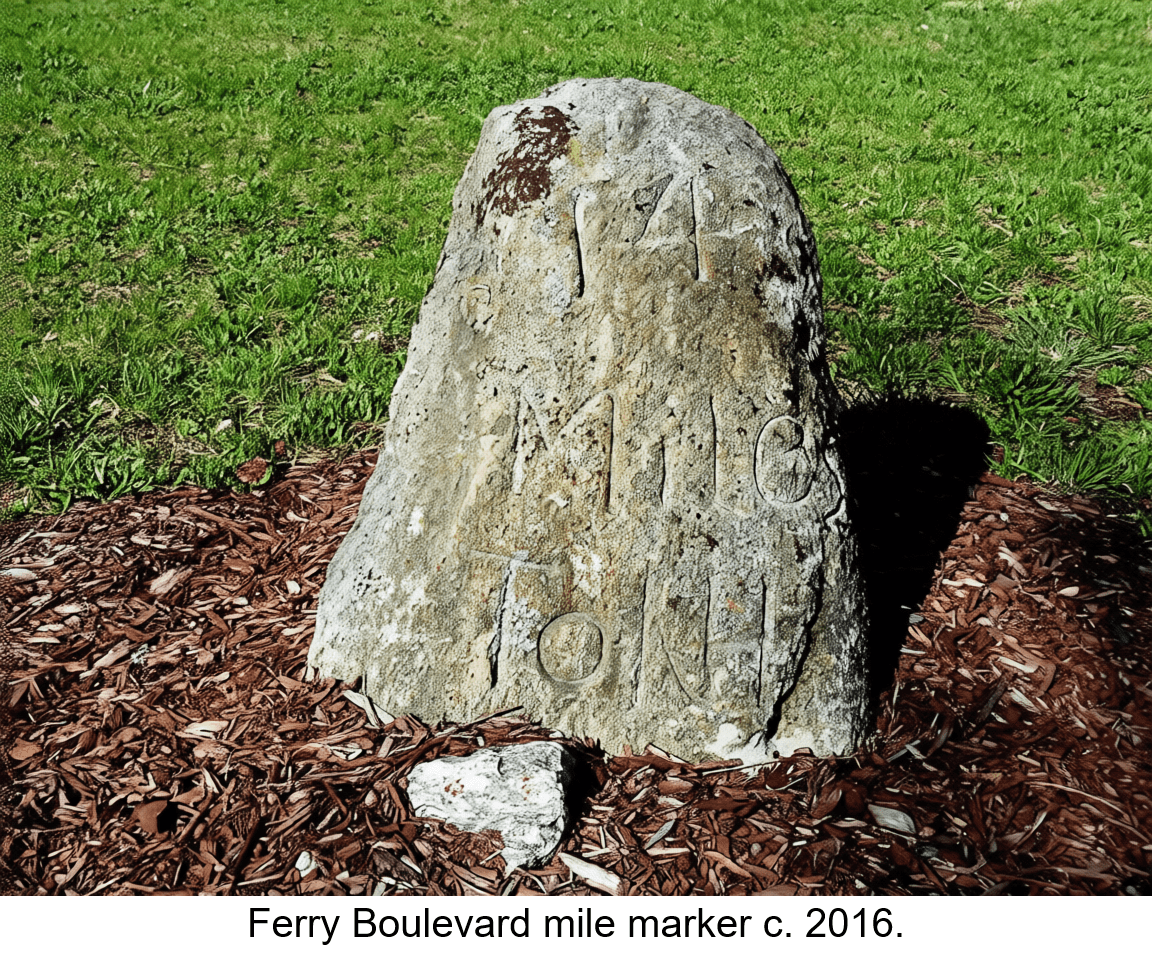
In Wilcoxson’s History of Stratford he writes: “Reminiscent of the days when Ferry Boulevard was an important part of the ‘Old King’s Highway,’ and the Stage Coach and Colonial Post Riders were dependent on Stratford Ferry for passage across the Housatonic River, there is yet standing on the east side of the road, a few rods south of ‘Ferry Bridge Creek’, a small, rough field stone bearing the legend ‘14 miles to N. H. — 1768.’ Its crude letters, now almost obliterated by time and the elements, the result of continued exposure to the heat and frosts of nearly two centuries of New England weather, is one of four such stones yet remaining between Fairfield township and the Housatonic River.
These ancient markers are frequently referred to as Franklin Milestones and one tradition asserts that Benjamin Franklin, while Colonial Postmaster-General, rode over this route and determined and marked their positions by means of an in-genius device attached to the wheel of his coach, which showed each mile travelled. However well founded this tradition may be, there seems to be little or no documentary evidence to support it and the fact is that they were undoubtedly erected by the Selectmen of Stratford in consequence of ‘An Act to oblige the Several Towns on the Post Roads in this Colony to erect monuments showing the distances from the several County Towns on said Roads,’ adopted by the General Court in October, 1757. Not only were the Selectmen to erect and keep up these stones at the expense of the town within the space of five months after the raising of this Assembly, but they were also to replace any which ‘shall be beat down or defaced’ under a penalty of forty shillings for neglect to do so.
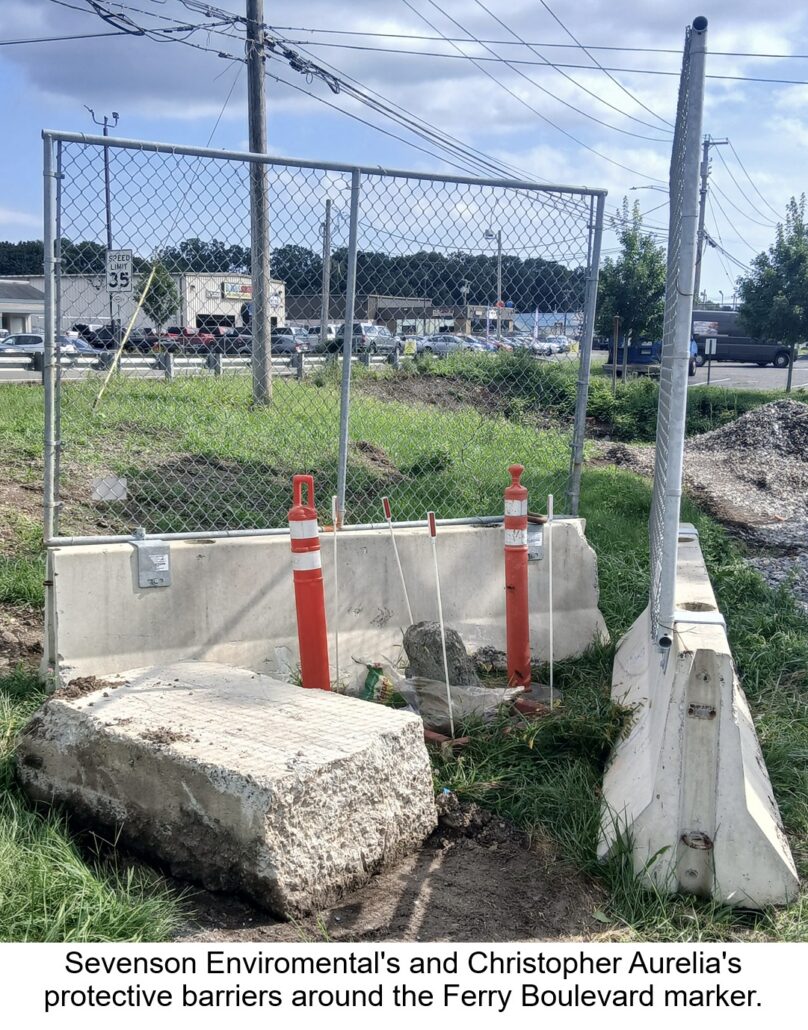
I can’t say why, but when I read Wilcoxson’s history, the preceding two paragraphs did not stick with me in the way that Knapp’s accounting of this incident had. As construction around the milestone marker on Ferry Boulevard has begun, once again, this historic marker has been in peril. Town residents have contacted the Mayor and me asking that something be done. Sevenson Environmental, one of the construction groups operating on Ferry Boulevard, has been kind enough, and generous enough, to put some Jersey barriers around the marker.
Kevin Moore, Gardens Chair of the Stratford Historical Society, recently reminded me that the story I’ve been telling, gleaned from Mr. Knapp’s history, was unfounded. Kevin shared with me a link from the State’s website, Mylstoning In Connecticut, 1757-1971, which clearly states the legend of Ben Franklin setting the postal markers in Stratford is just that: a legend.
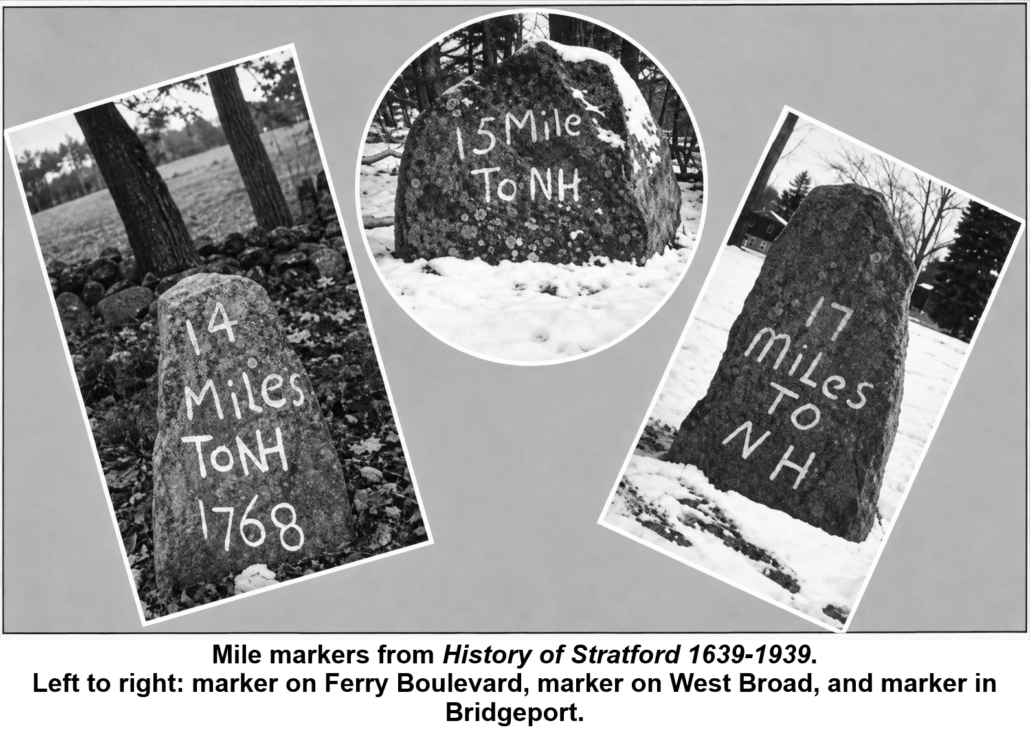
That’s when I decided to re-read what William Howard Wilcoxson had written in 1939. To all of you who believe, as I did, that legend Lew Knapp shared with us in 1989, all I can say is we should have read Wilcoxson’s history first. Maybe Wilcoxson’s explanation of the placing of the milestones would have stayed with us and we would have realized Lew’s legend of how the markers were placed by Franklin was just that— a legend.
And that, my friends, brings us to Stratford Legends and Lore #601. To those of you who have been duped, as I was, into believing the 1989 account of the placing of the postal markers, I apologize. I should have studied Wilcoxson’s treatise more carefully.
The story does not end here, however. The Mayor and the Public Works Department are formulating a plan to better protect and educate the public on our historic markers. While Benjamin Franklin may have never touched either of our two mile markers, that doesn’t diminish their historic value. Fortunately, we now have the correct story to print on future explanatory markers to be placed on West Broad and on Ferry Boulevard.

