

Stratford’s Revolutionary War story actually begins in 1690. Stratford had some type of very transformative experience involving an Episcopalian minister from New York City. His name was Rev. Visey. We have only a legend written by Rev. Samuel Peters in 1783 describing what occurred in 1690. Samuel Peters lived in the Captain Birdseye home on the corner of Main Street and Birdseye Street for 20 years prior to the American Revolution.
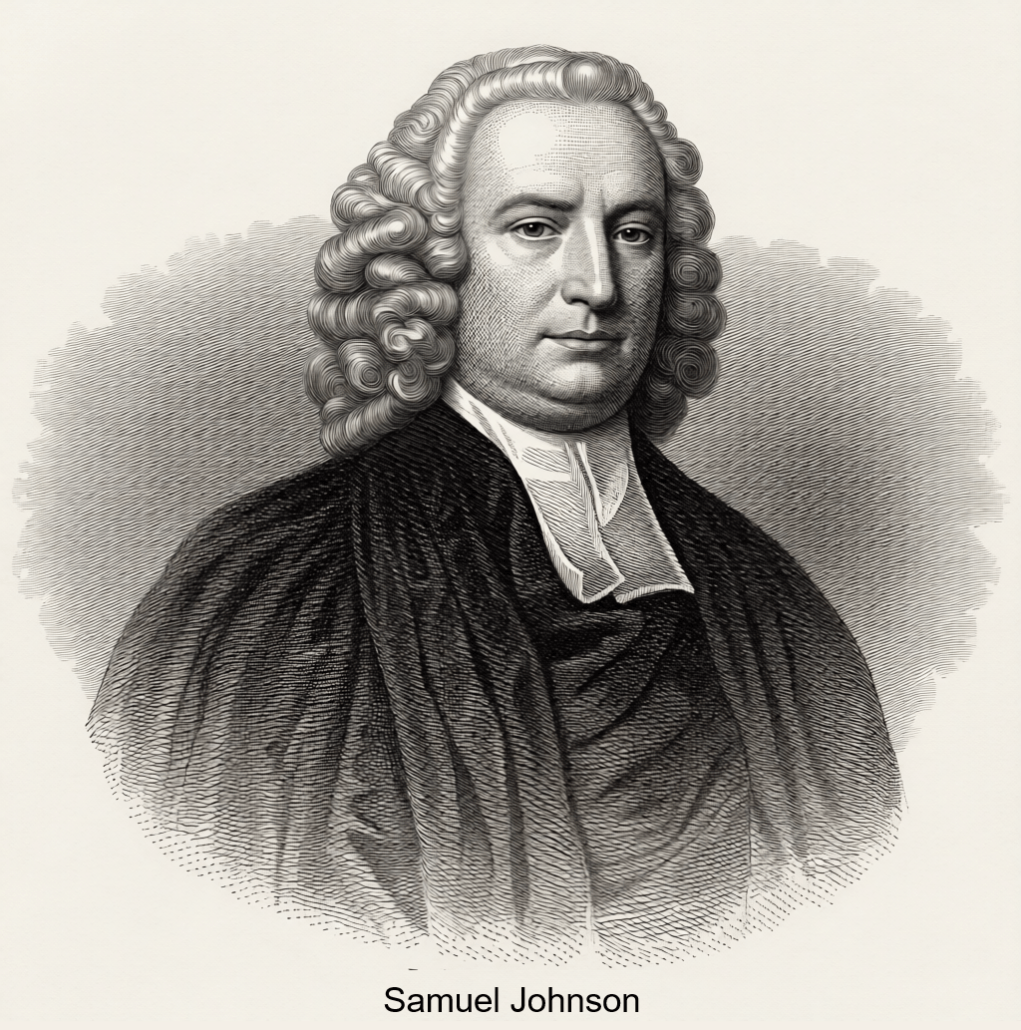
By law, from 1620 through at least 1717, no one who was not a devout Puritan (Congregationalist) was permitted to live in Connecticut or Massachusetts towns. All other religions were banned. The Rev. Visey “incident” set the stage for Rev. Samuel Johnson, a Congregational minister and founder of Yale College who converted to the Episcopalian faith, to settle in Stratford. Rev. Johnson began holding Episcopal services in Stratford in 1717, and built the first Episcopal Church in Connecticut or Massachusetts in 1723.
Many prominent citizens left the Congregational Church and joined Samuel Johnson. Consequently, when no other town in Connecticut or Massachusetts would have allowed an Episcopal Church to be established in their town, Stratford was receptive to the idea. This set the stage for Stratford’s divided views leading into the Revolutionary events beginning in 1773.
Samuel Johnson was one of the founders of Yale College and was its first instructor. In 1731 he wrote An Introduction to the Study of Philosophy, exhibiting a General view of all the Arts and Sciences. In that treatise, intended “for the use of young students” at the universities, it laid out a methodical college curriculum with the stated goal of one being educated for “the pursuit of happiness.” You may recognize those symbolic and lasting words, which Thomas Jefferson borrowed in 1776 for the opening paragraph of the Declaration of Independence.
The strength and leadership of Johnson had a dramatic influence on Stratford as it entered 1775. The town found itself divided in sympathies to the American Revolution, with about a third of the residents being dedicated Patriots, about a third being dedicated to the English, and the final third being totally indifferent to the causes of the Patriots or the English. However, for the most part, Stratford’s Loyalist (Tory) residents were generally very subdued in their support for England.
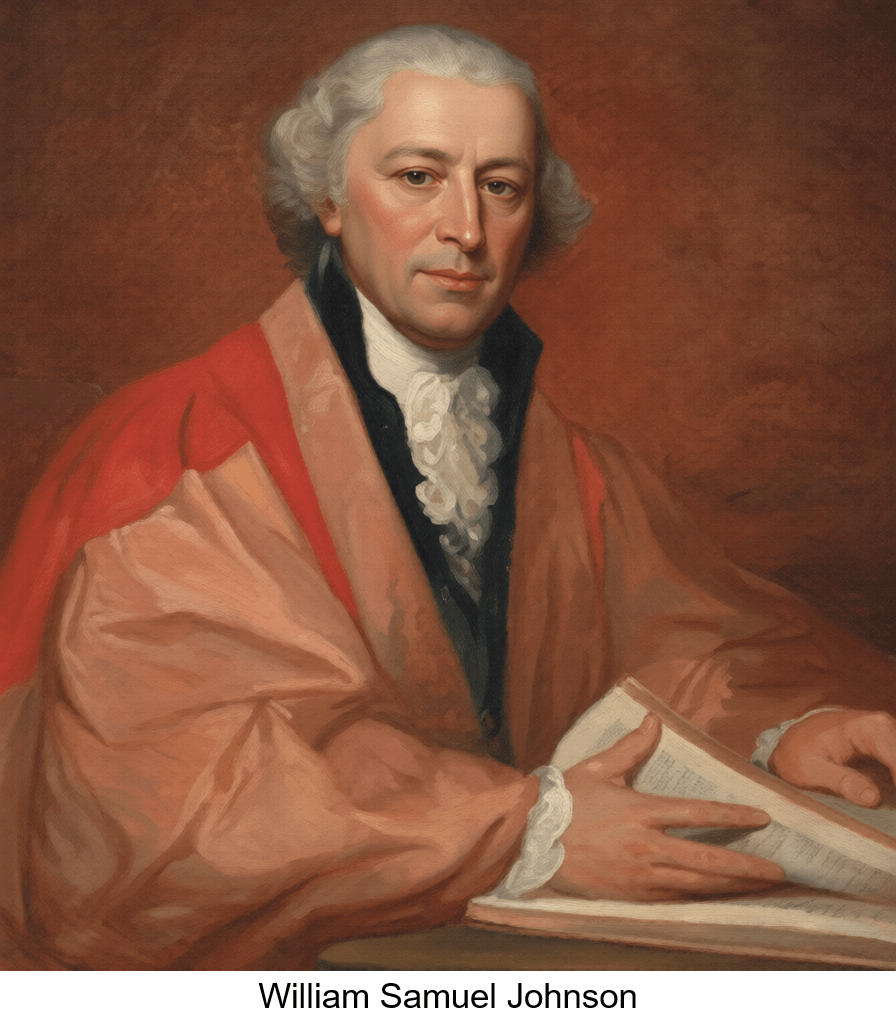
William Samuel Johnson, Samuel Johnson’s son, had spent seven years prior to the Revolution fighting to establish the legitimacy of the Colony of Connecticut in England. While living in England, William also fervently strove to convince his many influential British friends to avoid any armed conflict with the American colonies. He won over many prominent English people to view America more sympathetically, but, of course, to no avail.
When William returned home, he could not dedicate himself fully to the Patriot’s cause due to his many English friends and colleagues. He remained neutral throughout the war. In May of 1775, he was invited to the Second Continental Congress in Philadelphia to represent the Connecticut Colony. He declined the invitation due to his divided loyalties. It is widely suspected, however, that after the British burned Fairfield in July of 1779, they sailed right past Stratford due to Johnson’s presence in town.
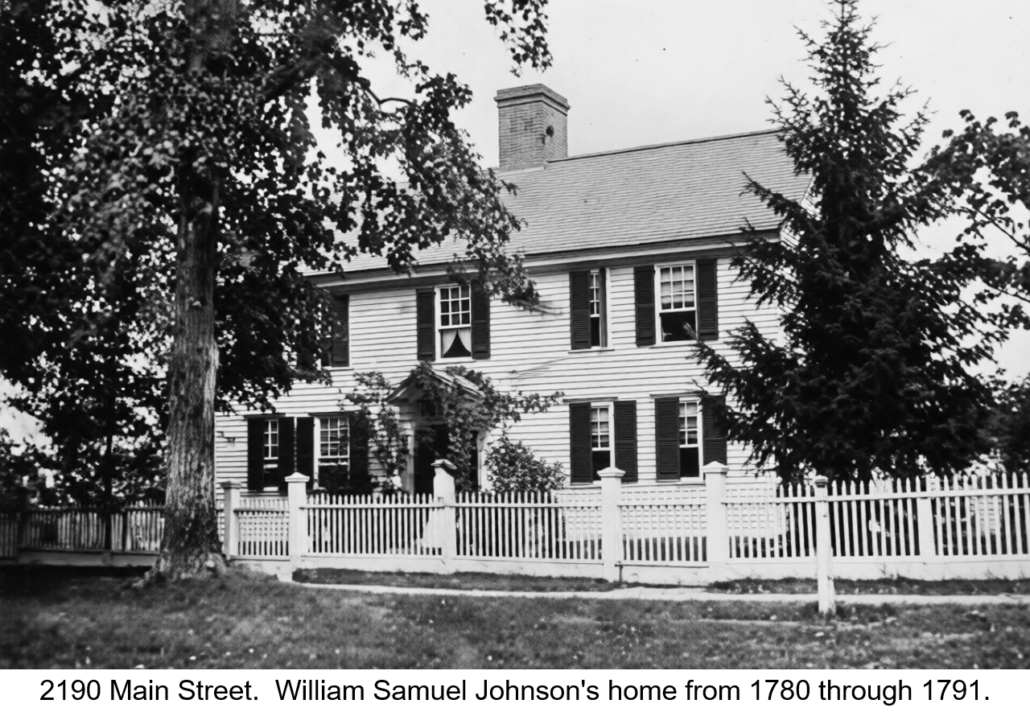
Interestingly, a known Tory (Dr. Joseph Clark) was turned out of his home at 2190 Elm Street in 1780. Johnson purchased the home and lived there until 1791 to prevent the home from falling into any other Tory’s hands.
William Samuel Johnson became an editor and signer of the Constitution of the United States. He forcefully fought for the adoption of the Constitution at the Connecticut Constitutional Convention in Hartford in 1788. He was elected to represent Connecticut as its first United States Senator in 1789.
While Samuel Johnson established and was named the first President of Kings College in 1754, the College was renamed Columbia College following the Revolutionary War. William Samuel Johnson was named President of the renamed Columbia College in 1787. If you visit the old burying grounds located behind St. James Church, you’ll see a plaque at the front gate honoring the two Johnson men, placed there by Columbia University,.
Sadly, outside of the Town of Stratford, few people are aware of two of America’s most amazing founding fathers and their notable and significant influence on America’s destiny.


I hold Mr. Wright in high esteem. He has spoken at the Stratford Senior Men’s Club, at the Baldwin Center many times over the past few years. He is well spoken and loves to tell stories about Stratford. We love to hear them and don’t ever get enough.